Mauro Cateb, “Akoya pearls” / Flickr, CC BY-SA 2.0. Resized and WebP-compressed; no crop or retouch. This derivative retains CC BY-SA 2.0. Image source CC BY-SA 2.0
Mauro Cateb, “Akoya pearls” / Flickr, CC BY-SA 2.0. Resized and WebP-compressed; no crop or retouch. This derivative retains CC BY-SA 2.0. Image source CC BY-SA 2.0
Mauro Cateb, “Akoya pearls” / Flickr, CC BY-SA 2.0. Resized and WebP-compressed; no crop or retouch. This derivative retains CC BY-SA 2.0. Image source CC BY-SA 2.0
Akoya, South Sea and Tahitian Pearls: Three Families, More Than Three Looks
Meet three saltwater pearl families through their hosts, colour, growth and documented research surprises—not a quality ladder.
Akoya, South Sea and Tahitian are distinct saltwater pearl-family contexts. Their names do not settle every question about appearance or origin. Compare actual colour, scale, shape and evidence rather than treating the three names as quality grades.
A first impression worth looking beyond
Put an Akoya strand, a golden South Sea pendant and a dark Tahitian pearl beside one another, and the familiar categories seem to explain themselves. White, gold, black: three colours, three boxes.
It is a useful first impression—and a poor place to stop. White and golden South Sea pearls belong within the same host-species family. Tahitian pearls are not uniformly black. What looks like a simple colour chart is really a meeting of biology, cultivation, light and market vocabulary.
The best comparison starts with the families, then looks at what changes inside each one. A few carefully documented research examples make that variety much more tangible than a ladder from “good” to “best.”
The family map
Here are the main host associations for the three saltwater cultured-pearl groups discussed in this article:
| Group | Host context | A useful starting distinction |
|---|---|---|
| Akoya | The Pinctada fucata species complex, including relevant hybrids | Not a guarantee of one country of origin |
| South Sea | Pinctada maxima | Includes white and golden pearl markets |
| Tahitian | Black-lipped Pinctada margaritifera | A broader palette than the everyday meaning of “black” |
Sources: GIA’s hybrid Akoya study, South Sea colour study and Tahitian colour research.
The names organize the comparison; they do not finish it. If two pearls belong to the same family, they can still differ visibly. If they look similar, they need not share the same biological origin. That is why a family map works best alongside an actual specimen, rather than replacing one.
Akoya: familiar roundness, an unexpectedly varied interior
Many readers first meet Akoya as a white or cream strand. That association is reflected in GIA’s general description, but it is an introduction rather than an exhaustive specification.
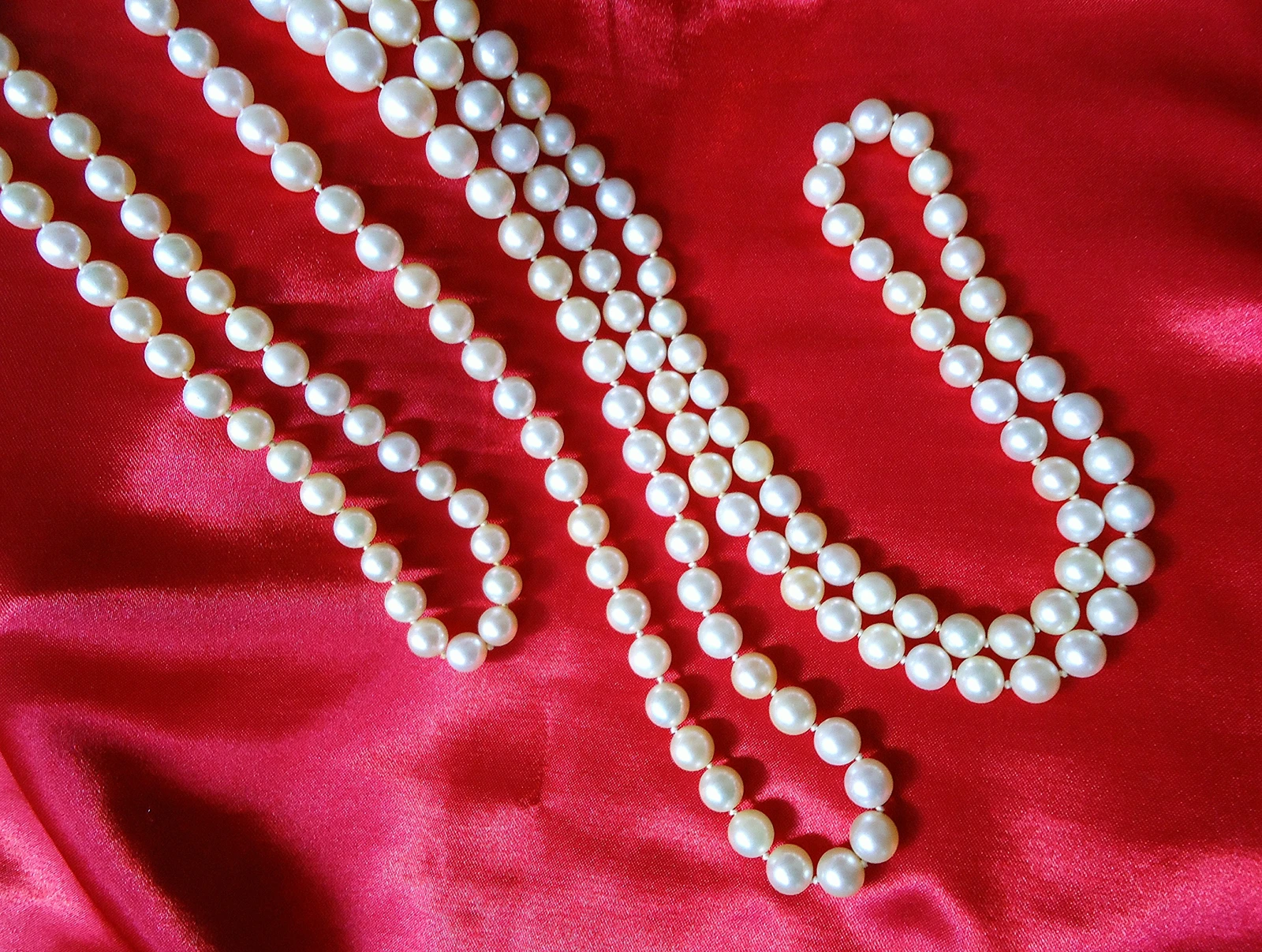
In the accompanying photograph, identified by photographer Mauro Cateb as Akoya pearls, several pale strands curve across red fabric. The repeated rounded outlines make the arrangement easy to follow. The photograph illustrates that visual rhythm; its red surroundings and strong highlights are not a standardized assessment of colour or lustre, and the pearls are not Hazelnut products.
Mauro Cateb, “Akoya pearls” / Flickr, CC BY-SA 2.0. Resized and WebP-compressed; no crop or retouch. This derivative retains CC BY-SA 2.0. Image source CC BY-SA 2.0
The inside can be more surprising than the familiar outside. A 2025 GIA study examined 91 hybrid Akoya pearls reportedly produced in Vietnam. Four approximately 6 mm specimens had measured nacre thicknesses of 1.62–1.68 mm. These were unusual study samples, not a new default thickness for all Akoya. Lawanwong, Atchalak and Yazawa
That finding changes the mental picture in a useful way. An unusual finding need not replace one rigid expectation with another. It can instead make us curious about the specific object, leaving room for a closer examination.
A name is a useful beginning for a conversation, but a particular object should still have room to surprise us. That is the pleasure of looking beyond a familiar label: the category becomes more interesting, not less useful.
South Sea: why white and golden are related
South Sea pearls are associated with Pinctada maxima, the oyster represented by the gold-lipped shell photograph here. The visible golden edge is a feature of that identified shell; it is not a colour certificate for an unseen pearl.
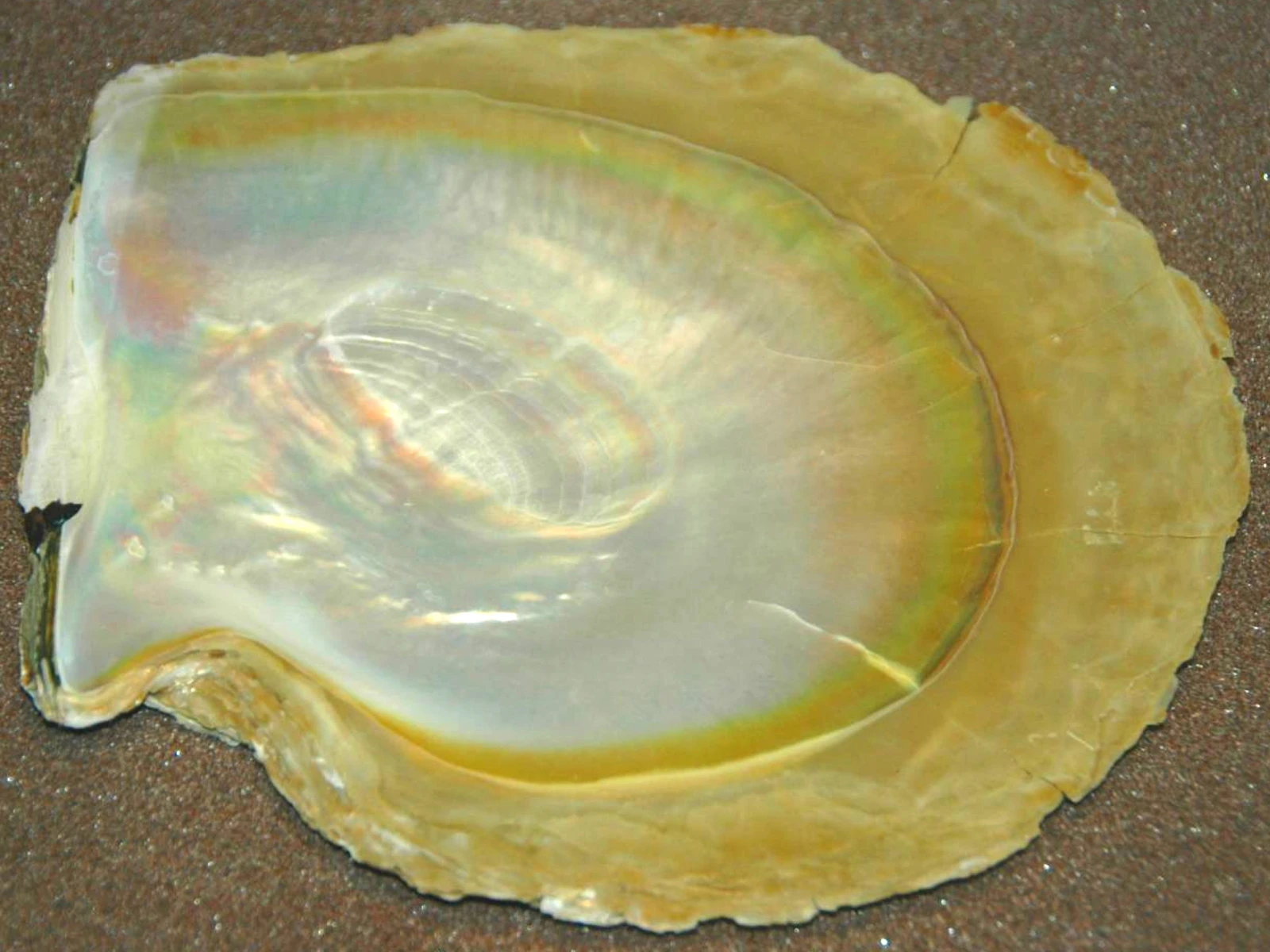
James St. John, “Pinctada maxima (gold-lipped pearl oyster)” / Flickr, CC BY 2.0. Resized and WebP-compressed; no crop or retouch. Image source CC BY 2.0
Stefanos Karampelas’s 2012 study describes the familiar South Sea range from white and silver-grey through cream to yellow and golden, while also examining less familiar colours. Its 21 selected samples were represented as natural-colour pearls. Their spectra suggested combinations of pigments rather than one simple colouring explanation. Gems & Gemology, full paper
A catalogue and a scientific discussion need not organize their subjects in identical ways. One arrangement helps someone browse by appearance; another helps a researcher frame a biological question. Keeping the purpose in mind makes both easier to read.
In 2023, GIA examined a heart-shaped golden South Sea cultured pearl. Imaging revealed a heart-shaped nucleus, with no evidence that the outer shape had been carved after growth. Ho and Yazawa, “Heart-Shaped Golden South Sea Cultured Pearl”
That particular specimen makes cultivation and finished form more interesting than “round is real, unusual must be imitation.” A memorable shape can invite a question about its making, rather than supply its own answer.
Tahitian: dark colour can contain a surprisingly lively palette
The phrase “black pearl” encourages us to imagine an even black surface. That picture misses much of the interest of Tahitian pearls. The 2016 research below includes natural pistachio-like hues in P. margaritifera.
To look more carefully, separate bodycolour, the main overall colour, from an overtone, a secondary hue seen over it; orient refers to an iridescent rainbow effect. These are distinct descriptions in GIA’s quality framework. A pearl’s dominant grey and a coloured effect across it need not be competing answers to “What colour is it?”
That vocabulary explains why one fixed colour word can feel inadequate in person. Turn an object and look again: you may be responding to a different part of its appearance rather than discovering that the first description was necessarily false. For the same reason, a brightly lit close-up and a distant view should not be expected to communicate identical visual information.
The interest lies in the relationship between the darker field and the colour that plays across it. A dark pearl need not disappear into a dark outfit in the imagination; equally, a colourful photograph does not promise the same saturated effect under every light. The most useful description allows room for that visual complexity.
“Peacock” describes a colour range, not the whole pearl
GIA’s 2023 “peacock” comment concerns qualifying P. margaritifera colour: green bodycolour with defined saturation, tone and overtone/orient criteria. It is not an overall quality grade. GIA announcement
The distinction is useful even when no report is in front of you. A colour can be appealing while the piece still needs to be considered as a complete jewel. Does a pair work together? Is the shape doing what the design needs? A colour term answers a colour question; it does not silently answer all the others.
Here, “peacock” refers specifically to GIA’s comment, not another laboratory’s designation.
Pistachio provides a real lesson about colour origin
The 2016 GIA study compared 12 pearls treated by Ballerina Pearl Co. with eight natural-colour pistachio pearls. Its investigators did not detect a foreign colouring agent in the treated material. Treatment therefore could not be reduced to “someone added dye.” Zhou and colleagues
The consumer lesson can be stated once, without turning the whole comparison into a warning label. Keep the visible colour, its origin and any laboratory conclusion as separate pieces of information. We can discuss a beautiful greenish hue without guessing its treatment history from a photograph.
Why a few millimetres change the impression so much
Size is often where these families feel most different in a piece of jewellery. But rather than imposing rigid size limits on each family, consider a simple geometric comparison.
Imagine two ideal spheres, one 8 mm across and the other 12 mm. The larger diameter is only 1.5 times the smaller. Its circular silhouette area, however, is 2.25 times as large, because area scales with the square of diameter. Its volume is 3.375 times as large, because volume scales with the cube.
This is an illustrative calculation, not a measurement of the pictured pearls or a rule for their weights and prices. Actual pearls may not be spherical; their interiors and settings also differ. Still, the calculation explains why a change that sounds small on a ruler can feel substantial when you see a pendant or a pair of earrings.
It also suggests a fairer comparison. If you want to explore colour differences, compare pieces of roughly similar scale first. If you want to understand scale, compare different sizes without simultaneously changing every other design feature. You do not need to conduct an experiment; you are simply giving your eye one question at a time.
Three families, not three rungs on a ladder
Akoya offers more than a country label. South Sea rewards looking beyond a two-box colour chart. Tahitian brings bodycolour and optical effects into an especially engaging conversation. None is a substitute for considering the actual pearl.
The research stories add depth to familiar categories. A closer look can change our expectation of what lies inside a pearl, how its shape developed, or how its colour came about. These are materials made through living processes and interpreted through evidence—not uniform objects manufactured to fit a slogan.
Start with the family that catches your interest. Then let the particular jewel become more specific than its name.
Questions about the three pearl families
Sources
- Kwanreun Lawanwong, Ravenya Atchalak and Emiko Yazawa / GIA, Exceptional Nacre Thickness of Hybrid Akoya Bead Cultured Pearls, 2025.
- GIA, Pearl Description.
- Stefanos Karampelas / GIA, Spectral Characteristics of Natural-Color Saltwater Cultured Pearls from Pinctada Maxima, 2012; full paper linked in the text.
- Joyce Wing Yan Ho and Emiko Yazawa / GIA, Heart-Shaped Golden South Sea Cultured Pearl, 2023.
- GIA, Pearl Quality Factors.
- GIA, GIA Adds “Peacock” Color Range Comment to All Pearl Reports, 2 May 2023.
- Chunhui Zhou and colleagues / GIA, Identification of “Pistachio” Colored Pearls Treated by Ballerina Pearl Co., 2016.
- Mauro Cateb, Akoya pearls, photograph; CC BY-SA 2.0.
- James St. John, Pinctada maxima shell, photograph; CC BY 2.0.
Card image credits
- Featured card: Mauro Cateb, “Akoya pearls” / Flickr, CC BY-SA 2.0. Resized and WebP-compressed; no crop or retouch. This derivative retains CC BY-SA 2.0. Image source CC BY-SA 2.0
- Article card: Mauro Cateb, “Akoya pearls” / Flickr. 4:3 crop, WebP; derivative retains CC BY-SA 2.0. Image source CC BY-SA 2.0
Hazelnut Select Studio is a Vancouver studio specialising in saltwater cultured pearls — Akoya, South Sea Gold and White, Black Tahitian and Keshi. Pearls are selected and matched in Japan; pieces with a certificate carry one issued by Pearl Science Laboratory, Tokyo. Viewings are in Vancouver, in person and by appointment.