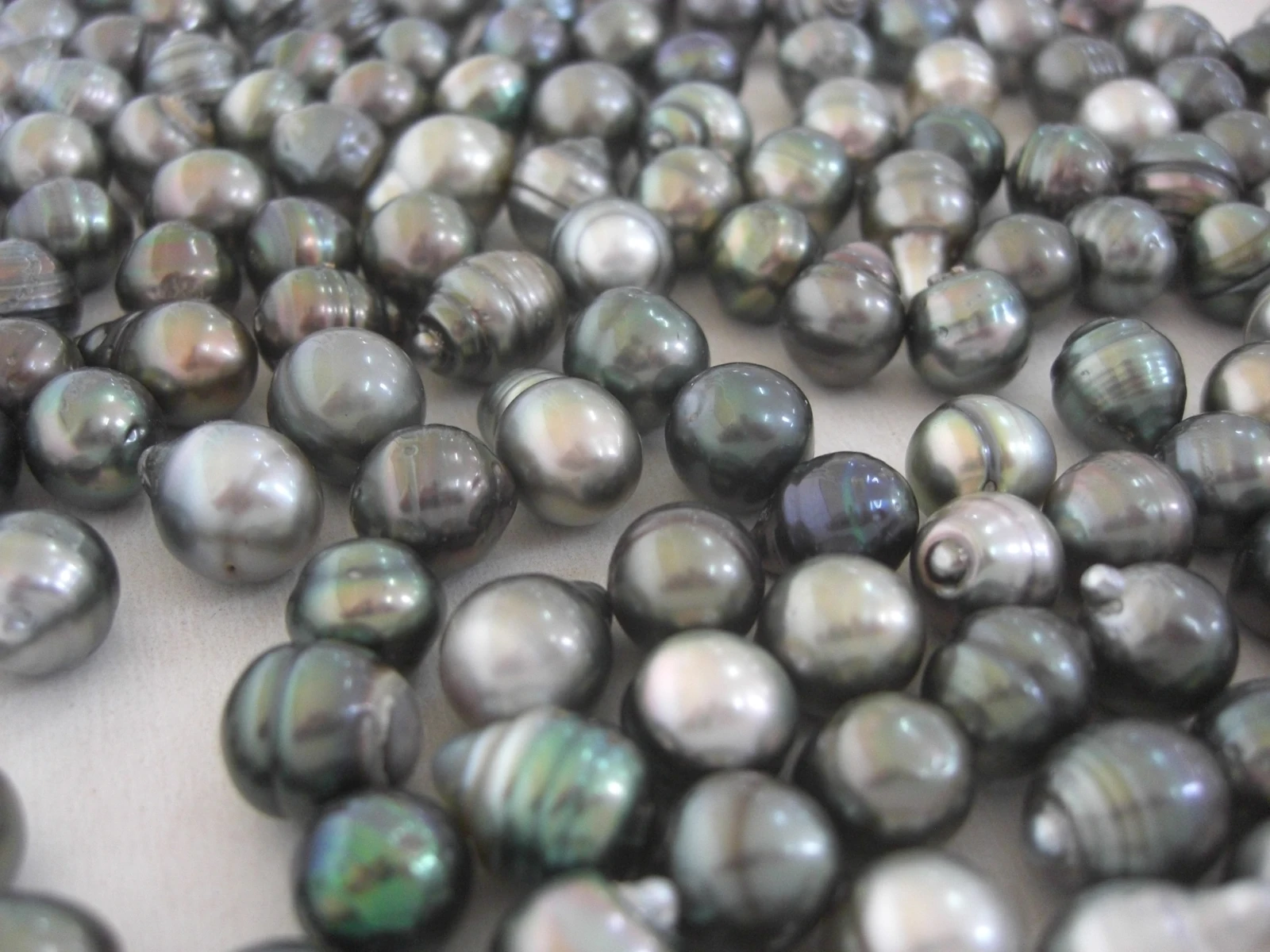
Archive pearl-farm photograph; not Hazelnut inventory. Appearance does not establish bead status or colour treatment. Olivier Bruchez, Rangiroa (pearl farm), 7 June 2012. CC BY-SA 2.0. Resized and converted to WebP. Image source CC BY-SA 2.0
Archive pearl-farm photograph; not Hazelnut inventory. Appearance does not establish bead status or colour treatment. Olivier Bruchez, Rangiroa (pearl farm), 7 June 2012. CC BY-SA 2.0. Resized and converted to WebP. Image source CC BY-SA 2.0
Archive pearl-farm photograph; not Hazelnut inventory. Appearance does not establish bead status or colour treatment. Olivier Bruchez, Rangiroa (pearl farm), 7 June 2012. CC BY-SA 2.0. Resized and converted to WebP. Image source CC BY-SA 2.0
Bead or No Bead? How Saltwater Cultured Pearls Actually Grow
A pearl-sac explanation of bead and non-bead saltwater culture, with real laboratory cases and limits of visual identification.
Bead-cultured saltwater pearls grow around an inserted nucleus within a pearl sac; non-bead cultured pearls develop without a retained bead. Both are cultured. A bead is not the tissue that produces pearl material, and no bead does not mean natural origin, a uniformly nacreous interior or a guaranteed quality level.
A pearl can contain another pearl. That sounds like the beginning of a jewellery fairy tale, but it is a documented laboratory finding—and a useful way into a question that is often made too simple: what does “bead-nucleated” really mean?
The distinction is about how a cultured pearl develops, not whether it is real. Nor is it a shortcut from a production method to beauty. To understand it, we need to look past the polished surface and separate two very different things: the material placed inside the oyster and the living tissue that makes the pearl around it.
Start with the living tissue, not the bead
The important structure is the pearl sac. Smithsonian zoologist John Pfeiffer describes pearl formation in terms of shell-producing tissue displaced into a pocket where a pearl can develop. This is a more useful starting point than the familiar story of an oyster merely wrapping a grain of sand. The biological machinery matters, not just the presence of an object. Emma Denes, Smithsonian Ocean
In bead culturing, a technician typically introduces a small piece of donor mantle tissue alongside a bead. The tissue forms the pearl sac; the bead supplies an initial form rather than producing pearl material. Research on silver-lipped pearl oysters describes this distinction. McDougall and colleagues, Frontiers in Genetics
For the nacreous pearls discussed here, nacre is a layered composite: tiny tablets of aragonite, a form of calcium carbonate, associated with an organic matrix. The pearl sac supplies substances involved in this biomineralization; successive mineral-and-organic layers build the growing pearl rather than the bead itself expanding. This explanation concerns nacreous pearls, not every kind of pearl produced by a mollusk. Zhang and colleagues, Heliyon, sections 1.4–1.5
That distinction changes how we imagine a cultured pearl. It is not a little factory-made ball that simply becomes larger on its own. There is an intervention, then a living growth process. “Cultured” identifies the human role in initiating that process; it does not erase the biological work that follows.
It also keeps our vocabulary honest. Calling the bead a “seed” may make the idea approachable, but a pearl is not a plant. For this article, bead means the inserted solid nucleus, and pearl sac means the tissue responsible for deposition. Keeping those two nouns separate prevents most of the confusion that follows.
A bead is a starting structure, not a quality score
In ordinary bead culture, the retained bead becomes part of the finished pearl. Material deposited around it creates the outer growth. But an inserted bead and a successful pearl are not interchangeable events: the oyster may reject the bead, and the growth history can take another course.
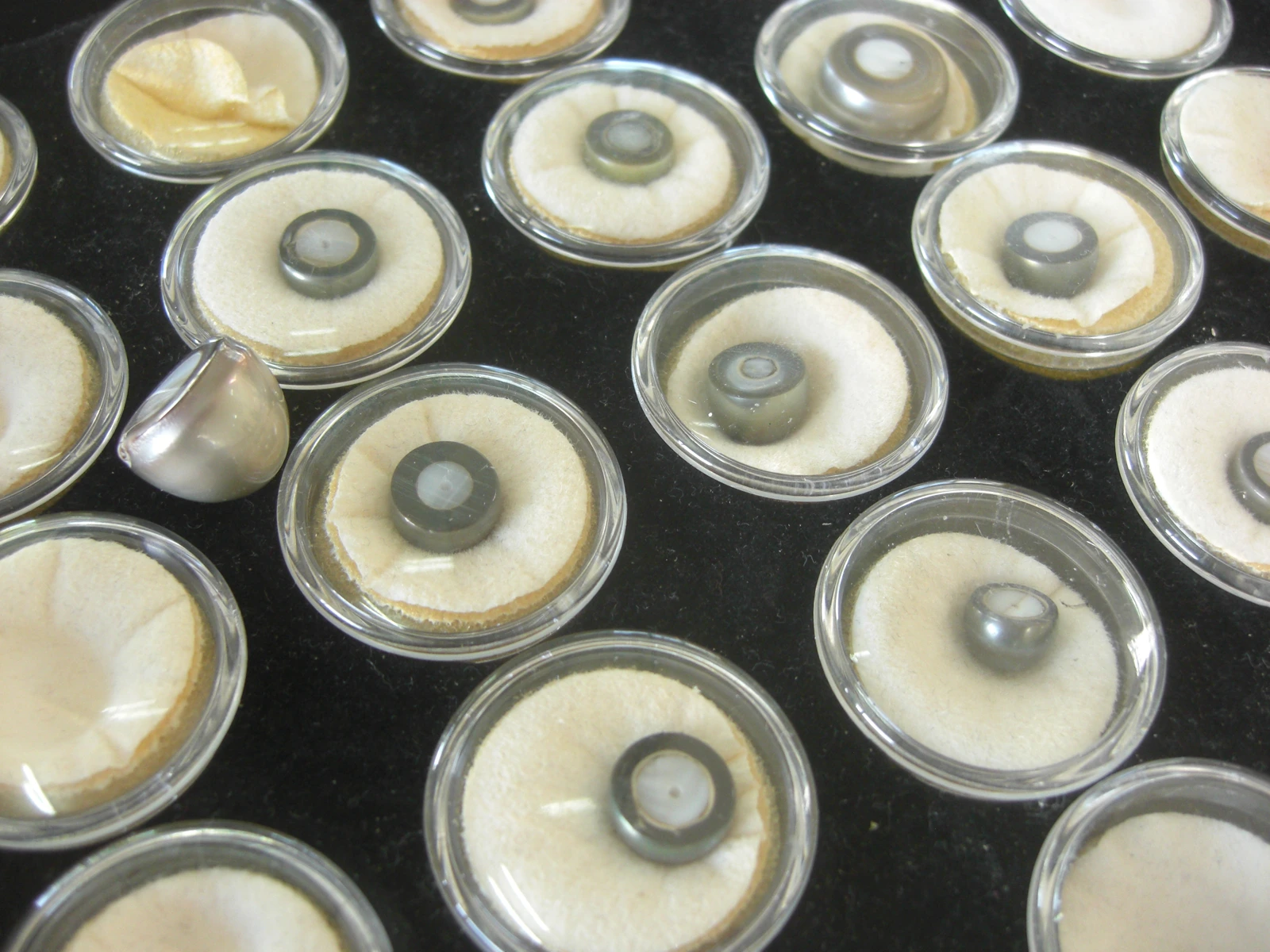
Archive photograph, not a laboratory image or Hazelnut product photograph.
Olivier Bruchez, Rangiroa (pearl farm). CC BY-SA 2.0. Resized and converted to WebP. Image source CC BY-SA 2.0
GIA’s 2021 study examined bead and non-bead Pinctada maxima pearls collected from operated gonads. Their known collection context connected the internal observations with cultured origin; some structures nevertheless remained difficult to interpret. Homkrajae and colleagues, GIA
The useful question is therefore not “Was there ever a bead nearby?” but “What growth route and final structure does the description refer to?” One describes the intervention; the other describes the resulting object. A careful explanation does not collapse the two.
Nor should the presence of a bead do the work of an aesthetic judgment. Imagine two hypothetical descriptions: “bead-cultured pearl” and “non-bead cultured pearl.” Neither tells you whether you prefer the finished piece on your ear, whether its shape suits a particular setting, or whether a pair looks harmonious together. The labels answer a formation question. They leave the visual encounter to you.
Without a bead does not mean without a centre
A pearl sac can produce a pearl without a retained bead. Non-bead cultured saltwater pearls are therefore not a contradiction, and the absence of a bead does not make their origin natural. The known-origin GIA study above illustrates that distinction.
“No bead” is narrower than “nothing inside.” A 2021 PNAS study documented an organic centre and subsequent mineral growth regions in a non-bead cultured akoya Keshi cross-section. Gim and colleagues, PNAS
We should be equally careful with the phrase “solid nacre.” Removing a shell bead from the explanation does not prove that every part of the interior is identical nacre. The negative statement—there is no bead—cannot by itself establish a complete positive description of everything that is present.
Ask what a label excludes before deciding what it guarantees. “No bead” is a precise statement; “nothing but nacre” is a different, larger claim.
The surprising case: a pearl used as the nucleus
Here is the promised pearl inside a pearl. In a GIA study published in 2020, 11 of 12 examined Pinctada maxima bead-cultured pearls had freshwater non-bead cultured pearls serving as their nuclei. The investigators used internal examination and analytical evidence to understand the construction. These were not ordinary shell-bead examples. Promlikit Kessrapong, GIA
This case is useful precisely because it resists a tidy picture. “Bead” describes a role in the culturing process; it need not mean the one familiar material a consumer happens to imagine. And “freshwater” can describe the nucleus without turning the surrounding marine-grown pearl into an ordinary freshwater pearl.
Do not turn the exception into a new market-wide claim. The study does not mean that every unusual pearl hides another pearl, or that this was the construction of anything in a jewellery photograph. Its value is explanatory: formation labels concern relationships between materials, tissues and growth, not just an outside silhouette.
What a photograph cannot tell you
The outside is not an X-ray. GIA examined 120 Pinctada margaritifera pearls supplied as non-bead cultured material and found five bead-cultured examples among them. An appealing irregular form was not sufficient evidence of the claimed internal type. Nilpetploy, Lawanwong and Kessrapong, GIA
Laboratory work combines evidence rather than relying on a single attractive clue. GIA’s account of its workflow describes radiography, more detailed micro-CT when needed, and chemical analysis for additional distinctions. It even notes that a freshwater bead can influence fluorescence seen through thin saltwater nacre. A response under a lamp is therefore not a complete home identification method. Phoebe Shang, GIA
That does not make a photograph useless. It can help you discuss visible shape, the arrangement of a necklace, or the way a pearl sits in a setting. It simply has a different job from internal imaging. We get better information when we let each kind of evidence answer the question it can actually answer.
A technical report has limits too. It speaks about the submitted item and the conclusions reached, not every pearl with a similar appearance. If a particular internal classification matters to the description, the evidence must stay attached to that particular object.
A clearer way to read the distinction
Try separating a pearl description into three questions:
- What started the process? Natural formation or human-initiated culture is one distinction.
- What internal route is being described? Bead-cultured and non-bead cultured address another.
- What do I actually enjoy about the finished jewel? This is where your response to its appearance belongs.
These questions are connected, but none is a substitute for the others. You can appreciate a fluid, uneven outline without calling it natural. You can admire a round pearl without assuming that a bead explains everything about it. And you can value an unusual growth history without pretending it supplies an automatic grade.
The most interesting part of the bead/no-bead distinction is not a winner. It is the glimpse it gives us of a material made through living processes—sometimes following the intended route, sometimes producing a more complicated story than the label first suggests.
Questions about bead and non-bead pearls
Sources
- Yingyu Zhang and colleagues, Research progress on formation mechanism of pearl, 2024; sections 1.4–1.5.
- Emma Denes / Smithsonian Ocean, How Oysters Create the Ocean’s Gems, July 2025.
- Carmel McDougall and colleagues, Pearl Sac Gene Expression Profiles Associated With Pearl Attributes in the Silver-Lip Pearl Oyster, Pinctada maxima, 2021.
- Artitaya Homkrajae and colleagues / GIA, Internal Structures of Known Pinctada maxima Pearls: Cultured Pearls from Operated Marine Mollusks, 2021.
- Jiseok Gim and colleagues, The mesoscale order of nacreous pearls, 2021.
- Promlikit Kessrapong / GIA, Atypical Bead Cultured Pinctada maxima Pearls Nucleated with Freshwater Non-Bead Cultured Pearls, 2020.
- Nanthaporn Nilpetploy, Kwanreun Lawanwong and Promlikit Kessrapong / GIA, Non-Bead-Cultured Pearls from Pinctada margaritifera, 2018.
- Phoebe Shang / GIA, How GIA Analyzes Pearls from Start to Finish, 2025.
Card image credits
- Featured card: Archive pearl-farm photograph; not Hazelnut inventory. Appearance does not establish bead status or colour treatment. Olivier Bruchez, Rangiroa (pearl farm), 7 June 2012. CC BY-SA 2.0. Resized and converted to WebP. Image source CC BY-SA 2.0
- Article card: Archive pearl-farm photograph; not Hazelnut inventory. Appearance does not establish bead status or colour treatment. Olivier Bruchez, Rangiroa (pearl farm), 7 June 2012. CC BY-SA 2.0. Resized and converted to WebP. Image source CC BY-SA 2.0
Hazelnut Select Studio is a Vancouver studio specialising in saltwater cultured pearls — Akoya, South Sea Gold and White, Black Tahitian and Keshi. Pearls are selected and matched in Japan; pieces with a certificate carry one issued by Pearl Science Laboratory, Tokyo. Viewings are in Vancouver, in person and by appointment.