Identified as freshwater pearls by the photographer; not Hazelnut inventory. No bead status, growing location or colour-treatment conclusion is supplied. Mauro Cateb, Greenish freshwater pearls, 2013. CC BY-SA 2.0. Full photograph resized and converted to WebP. Image source CC BY-SA 2.0
Identified as freshwater pearls by the photographer; not Hazelnut inventory. No bead status, growing location or colour-treatment conclusion is supplied. Mauro Cateb, Greenish freshwater pearls, 2013. CC BY-SA 2.0. Full photograph resized and converted to WebP. Image source CC BY-SA 2.0
Identified as freshwater pearls by the photographer; not Hazelnut inventory. No bead status, growing location or colour-treatment conclusion is supplied. Mauro Cateb, Greenish freshwater pearls, 2013. CC BY-SA 2.0. Full photograph resized and converted to WebP. Image source CC BY-SA 2.0
Freshwater Pearl Types: Four Different Stories Hidden in the Names
Freshwater cultured pearls include non-bead and bead-cultured routes. Names such as Edison, Biwa, coin and soufflé do not all classify the same thing: they can concern commercial usage, place, shape or technique. Read those layers separately; a trade name does not establish internal structure, colour origin or a universal grade.
Freshwater cultured pearls include non-bead and bead-cultured routes. Names such as Edison, Biwa, coin and soufflé do not all classify the same thing: they can concern commercial usage, place, shape or technique. Read those layers separately; a trade name does not establish internal structure, colour origin or a universal grade.
A freshwater-pearl description can sound like a family tree assembled from several different languages: Edison, Biwa, coin, soufflé, bead-nucleated, tissue-nucleated. The problem is not simply unfamiliar vocabulary. These words are answering different questions.
Some describe how a pearl was cultured. Some refer to a place. Others describe a shape or circulate as commercial names. If we put them all on the same branch, we create a wonderfully complicated diagram that explains very little.
A more useful approach is to keep four layers separate: formation method, geographical context, visible form and trade name. This does not rank freshwater pearls below or above saltwater pearls. It lets us read freshwater descriptions on their own terms—and see why “they are all beadless” is no longer an adequate explanation.
Begin with the method, not the marketing name
Fiske and Shepherd’s 2007 account of Chinese freshwater culture describes mantle-tissue grafting alongside coin-shaped and spherical bead culture. Both routes were documented well before today’s listings. Fiske and Shepherd, GIA
Tissue grafting introduces living tissue, not necessarily a hard bead. Non-bead culture still involves human intervention; it is not natural origin.
There are two common shortcuts to resist. The first is to equate freshwater with non-bead culture. The second is to equate non-bead culture with a particular outline. A production method is not a drawing of the finished pearl.
This becomes much easier if we ask a description to finish its sentence. “Freshwater” tells us the environment category. “Cultured” identifies the role of human intervention. A further statement about a bead gives another kind of information. Each word can add something; none needs to pretend it says everything.
Japanese freshwater pearls make a useful counterexample
Lake Kasumigaura provides a Japanese freshwater counterexample. GIA’s 2018 study documented bead culture in hybrid mussels there. Ahmadjan Abduriyim, GIA
The example separates two axes at once: Japan is a geographical context; freshwater is an environmental one. Neither word is a substitute for the other. It also shows why “freshwater pearls never contain beads” fails as a universal claim.
The account describes a drilled shell bead holding donor tissue, placed in the mussel’s gonad. It also illustrates round pearls in pink, purple, orange, pale yellow and cream. This is a concrete alternative to imagining all freshwater production as tissue-only grafting or all Japanese pearls as white marine pearls. Abduriyim, culturing account and Figure 3
These are documented production examples, not proof of the origin of every item sold under a similar name today.
Edison: a useful commercial name, not a complete identification
Edison is a commercial name, not a species. GIA examined 23 supplied “Edison” pearls: 19 bead-cultured and four non-bead cultured. The name did not establish their internal structure. Zhou and colleagues, GIA
The lesson is not to ban commercial vocabulary. Names can be useful shorthand in a conversation, and some become associated with a recognizable market offering. But a shorthand still needs unpacking when it carries the weight of a technical claim.
Consider a hypothetical listing headed “Edison freshwater pearl pendant.” That may help you recognize the sort of product being discussed. By itself, it does not give a full answer about the individual pearl’s internal construction, colour origin or quality. Those are separate fields, not information we should quietly imagine into the title.
This distinction also protects a good pearl from exaggerated expectations. A commercial name need not certify every appealing property before an individual jewel can be worth considering. It is the specific description and object that should do that work.
Colour has its own evidence question
The study also found treated examples, distinguishing colour treatment from optical brightening. Its submitted samples do not establish market-wide prevalence or the status of another photographed pearl. Zhou and colleagues, GIA
For a reader, the distinction is between what we see and how that appearance arose. “Pink,” for example, can be a description of visible colour. “Naturally coloured” makes an additional origin claim. The second does not automatically follow from the first.
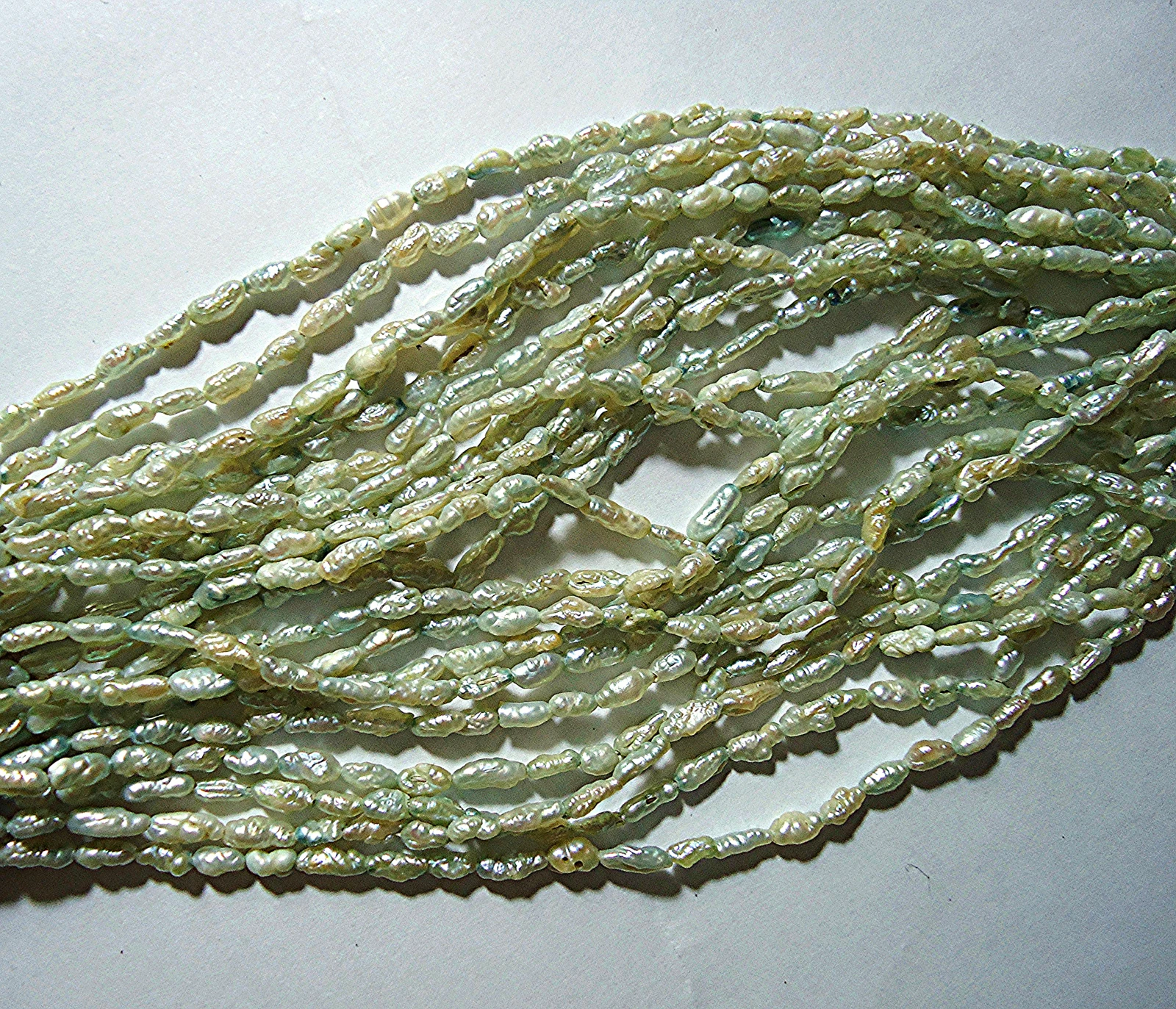
Identified as freshwater pearls by the photographer; not Hazelnut inventory. No bead status, growing location or colour-treatment conclusion is supplied.
Mauro Cateb, Greenish freshwater pearls, 2013. CC BY-SA 2.0. Full photograph resized and converted to WebP. Image source CC BY-SA 2.0
Keep colour origin separate from both a trade name and the fact that a pearl was cultured. One describes appearance and its cause; the other describes how formation began.
Soufflé, coin and other words do different jobs
A 2026 GIA account describes a regenerated freshwater culturing route for soufflé pearls using composite beads containing silt, incense ash and biological adhesive. Zhou and colleagues, GIA, note 2
The resulting product can also feel different. Duncan Pay’s 2015 reporting describes soufflé pearls as large baroque pearls with light heft, typically hollow after drilling. The airy name is useful as a way to picture that physical effect, not as a formal grade. Pay, GIA
“Coin,” by contrast, directs the eye toward a flattened form, although a technical account may also describe a coin-shaped bead. A shape word in a product title should not make us assume the entire production record. The same caution applies to highly evocative trade vocabulary: a name that suggests flames, ripples or a cloud is not a laboratory image of the interior.
Pay also documented round non-bead freshwater pearls and baroque bead-cultured products. Round and irregular therefore cannot be used as automatic substitutes for bead and non-bead. Pay, GIA
Biwa is a place; “freshwater Akoya” is not a new biological family
Biwa points to a real place, Lake Biwa in Japan. GIA’s 2021 study examined specimens supplied with that provenance, including two reportedly grown for 14 years. The researchers linked the story to identified samples and laboratory observations—not simply to an elongated shape. Nilpetploy and Katsurada, GIA
The distinction matters even when nobody intends to mislead. A word can migrate in casual trade usage until the original geographical meaning becomes blurred. Repeating it without explanation makes the blur worse. If the evidence establishes a shape but not a place, describe the shape.
The same 2026 account calls “freshwater Akoya” a misnomer, not a new Akoya identity. GIA, note 3
A comparison of appearance can be expressed as a comparison. It does not need to become a false identity. That is the difference between helping a reader picture something and moving it into the wrong category.
Read a description in layers
Here is an editorial way to untangle the vocabulary without memorizing an enormous list. Treat a listing as four possible statements:
- Method: what does it actually say about culturing and bead use?
- Place: is it naming a documented growing location, or only where something was purchased?
- Appearance: which words describe what can be seen?
- Commercial language: which terms are names used in the market rather than complete technical conclusions?
These are not four boxes every listing must fill. Unknowns should remain unknown, and a simple description can still be honest. The exercise is to stop one word from silently filling all four.
Imagine “Japanese Biwa-style coin pearl.” Before treating that phrase as a precise identity, separate its promises. Does “Japanese” mean grown or purchased there? Does “Biwa-style” merely suggest an appearance? Does “coin” describe shape or a supported culturing method? The example is hypothetical, but the reading problem is real: several attractive words can obscure rather than clarify what is actually known.
Freshwater pearl culture is interesting because it contains genuine technical and visual variety. We do not need to simplify it into “inexpensive beadless pearls,” nor inflate every commercial name into a new species. Once formation, place, form and naming are separated, the variety becomes easier to appreciate—and the individual pearl has room to speak for itself.
Questions about freshwater types
Sources
- Doug Fiske and Jeremy Shepherd / GIA, Continuity and Change in Chinese Freshwater Pearl Culture, 2007.
- Ahmadjan Abduriyim / GIA, Cultured Pearls from Lake Kasumigaura: Production and Gemological Characteristics, 2018.
- Chunhui Zhou and colleagues / GIA, Detection of Color Treatment and Optical Brightening in Chinese Freshwater “Edison” Pearls, 2021.
- Qishen Zhou and colleagues / GIA, Policy-Driven Sustainability in China’s Freshwater Pearl Culturing Industry, 2026; technical naming/process passages only.
- Duncan Pay / GIA, Chinese Freshwater Pearl Culturing, Overall Market Summary, 2015.
- Nanthaporn Nilpetploy and Yusuke Katsurada / GIA, Unique Non-Bead Cultured Freshwater Pearls from Lake Biwa, Cultured for 14 Years, 2021.
Card image credits
- Featured card: Identified as freshwater pearls by the photographer; not Hazelnut inventory. No bead status, growing location or colour-treatment conclusion is supplied. Mauro Cateb, Greenish freshwater pearls, 2013. CC BY-SA 2.0. Full photograph resized and converted to WebP. Image source CC BY-SA 2.0
- Article card: Identified as freshwater pearls by the photographer; not Hazelnut inventory. No bead status, growing location or colour-treatment conclusion is supplied. Mauro Cateb, Greenish freshwater pearls, 2013. Cropped card detail; derivative retains CC BY-SA 2.0. Image source CC BY-SA 2.0
Hazelnut Select Studio is a Vancouver studio specialising in saltwater cultured pearls — Akoya, South Sea Gold and White, Black Tahitian and Keshi. Pearls are selected and matched in Japan; pieces with a certificate carry one issued by Pearl Science Laboratory, Tokyo. Viewings are in Vancouver, in person and by appointment.