
Lawrence Jackson / White House; public domain. Image source Public domain — U.S. federal government work
Lawrence Jackson / White House; public domain. Image source Public domain — U.S. federal government work
Lawrence Jackson / White House; public domain. Image source Public domain — U.S. federal government work
Thatcher, Harris and Michelle Obama: Pearls in Public
A family gift, sorority colours, trainers and two black dresses: the stories and practical proportions behind three familiar pearl-wearing public figures.
Pearls enter these women’s public images through personal history, community and styling. Thatcher recalled a family gift; Harris’s pearls have a documented connection with Alpha Kappa Alpha. The photographs also show practical differences: spaced pearls on chains, close-set strands and the necklines that frame them. Michelle Obama appears here as a First Lady comparison.
A family story, then a closer look
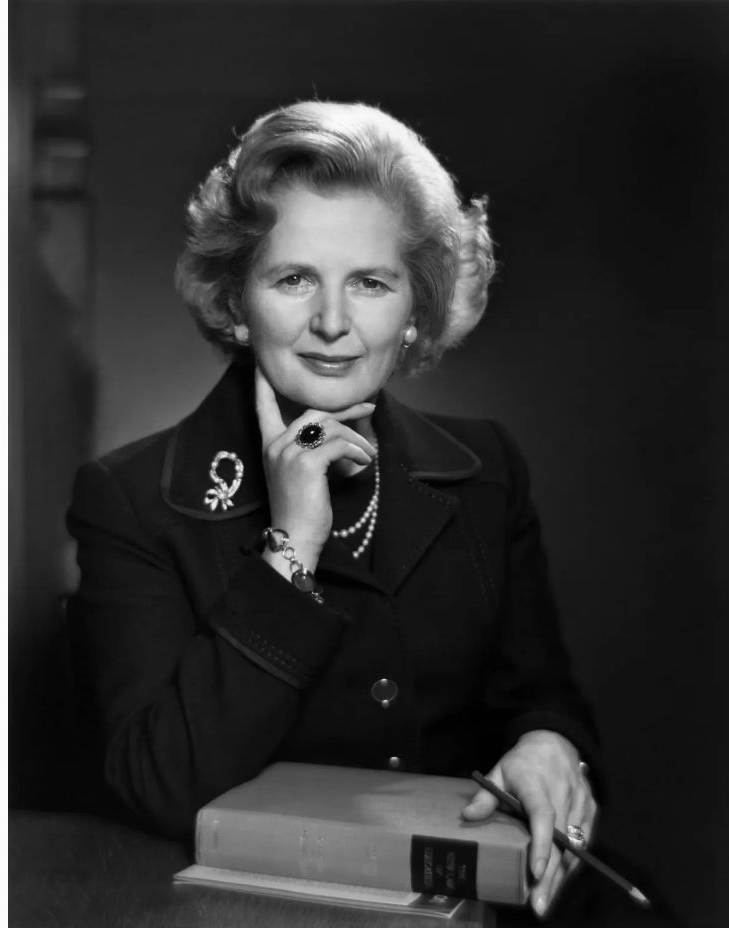
Source photograph screenshot; styling reference, not a product photograph.
© Yousuf Karsh / karsh.org Image source
Russell Harty began his 1987 BBC interview with Margaret Thatcher by bringing up her pearls. He saw something approaching an emblem of office; she remembered a present. Denis had given her the double strand when their twins were born in 1953. In her recollection, the afternoon also involved his attention to the Ashes. A question about the prime minister’s familiar appearance had opened a little door into family life. BBC interview transcript, Margaret Thatcher Foundation The earlier portrait beside this passage, made by Yousuf Karsh at the House of Commons in 1976, catches her before she became prime minister. Karsh’s image record Look at how much is happening around the necklace: a hand under the chin, a dark ring, a brooch, a bracelet, a book and a pen. The pearls emerge beside her hand in two curved lines. They share the portrait with a whole collection of small, emphatic shapes. It is a pleasingly complicated picture for anyone accustomed to imagining political dress as a plain suit plus one approved accessory. The interview gives us the family story; the photograph gives us a woman wearing several things at once.
Thatcher had plenty to say about clothes themselves. In her 1985 Vogue interview, she recalled her mother’s work as a dressmaker and urged shoppers to examine garments while moving and sitting, as well as standing before a mirror. Fit, construction and finishing absorbed her attention. Interview with Ingrid Bleichroeder Karsh’s portrait makes a good companion to that practical conversation. The broad collar turns outward around her neck; the line of the cuff leads toward the bracelet; the brooch occupies one side while the visible pearl strands occupy the other. Even in monochrome, the jewellery has different kinds of presence. The brooch reads as a small, bright outline, the ring as a dark centre, and the pearls as repeated points that guide the eye downwards. There is enough space between them for each shape to remain legible. For a contemporary jacket, that is a useful starting point: try the necklace with the lapels in their natural position, then sit down and see where the lowest strand lands. A favourite piece needs a comfortable place in the clothes you actually wear.
Community, trainers and an open jacket
The pink and green fabric behind Kamala Harris on Vogue’s February 2021 cover belongs to the story as much as the necklace does. Alpha Kappa Alpha’s official colours are salmon pink and apple green; the sorority was founded at Howard University in 1908. AKA’s history Harris joined in 1986. Smithsonian’s account connects her pearls with that community and explains the founders’ “Twenty Pearls” designation and pearl-set membership badges. Smithsonian Vogue describes Tyler Mitchell’s setting as a tribute to her sorority days and identifies the Donald Deal blazer and Converse trainers as her own styling choices. Vogue’s account of the cover In the picture, the white top leaves a bright opening inside the dark jacket, while the trainers carry that pale accent down to the floor. The necklace is small within the full-length composition. Pull back far enough to see the shoes, the loose fabric and her hands, and the familiar pearl accessory becomes part of a more relaxed ensemble. Here the whole outfit is worth keeping in the frame. A close-up of the necklace alone would lose both the styling and the sorority colours that surround it.
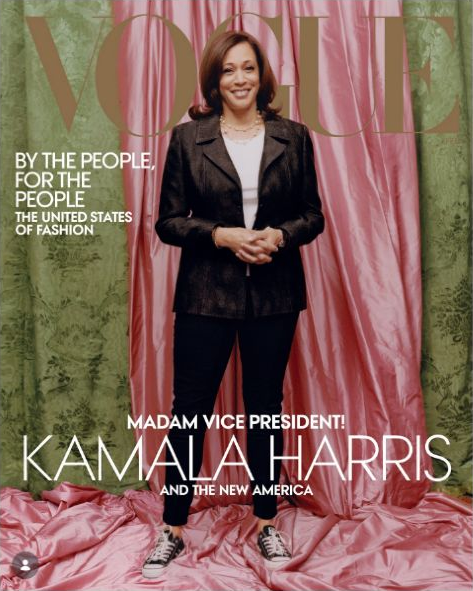
Instagram screenshot; styling reference, not a product photograph.
Tyler Mitchell / Vogue; source @voguemagazine. Image source
Lawrence Jackson / White House; public domain. Image source Public domain — U.S. federal government work
Harris’s 2021 official vice-presidential portrait offers a closer view. Lawrence Jackson’s photograph places her against flags, wearing a navy jacket and dark top. National Archives Her necklace sits on the exposed skin above that top, where the separate pale pearls and the gold-toned chain are easy to follow. Several lines descend through the open space between the lapels. The pearls are spaced apart, so the chain contributes to the drawing: little bright intervals, then another pearl, then another stretch of chain. The jacket’s sharp edges provide a steady frame for those softer curves. Compared with the Vogue cover, the shorter framing makes the jewellery much more prominent, even though the surrounding clothes remain dark. For everyday dressing, this offers a specific way to wear pearls with tailoring. Choose a top whose neckline leaves the necklace room to sit comfortably; check that the lowest loop clears the fabric edge instead of repeatedly catching it. A chain-and-pearl design also leaves more of the neckline visible than a closely strung row. The difference becomes obvious when you see the two arrangements side by side.
Two black dresses, two public settings
Michelle Obama’s 2009 official portrait has a different sense of space. She stands in a black sleeveless dress, one hand resting beside white flowers, with the room’s blue and gold furnishings still visible around her. Joyce Boghosian’s photograph presents her as First Lady, a different public role from the elected offices held by Thatcher and Harris. Portrait record In an excerpt from Becoming, Obama recalled the headlines about her arms after that sleeveless portrait and the frustration of having her clothes attract more attention than her words. Her memoir excerpt in ELLE The two pearl strands follow the rounded neckline in a compact, bright band. Below them, the uninterrupted black dress gives the eye a long, quiet area; on either side, bare arms keep the silhouette open. The wider view matters here too. The necklace takes its place within the dress’s proportions, rather than supplying the entire personality of the picture.

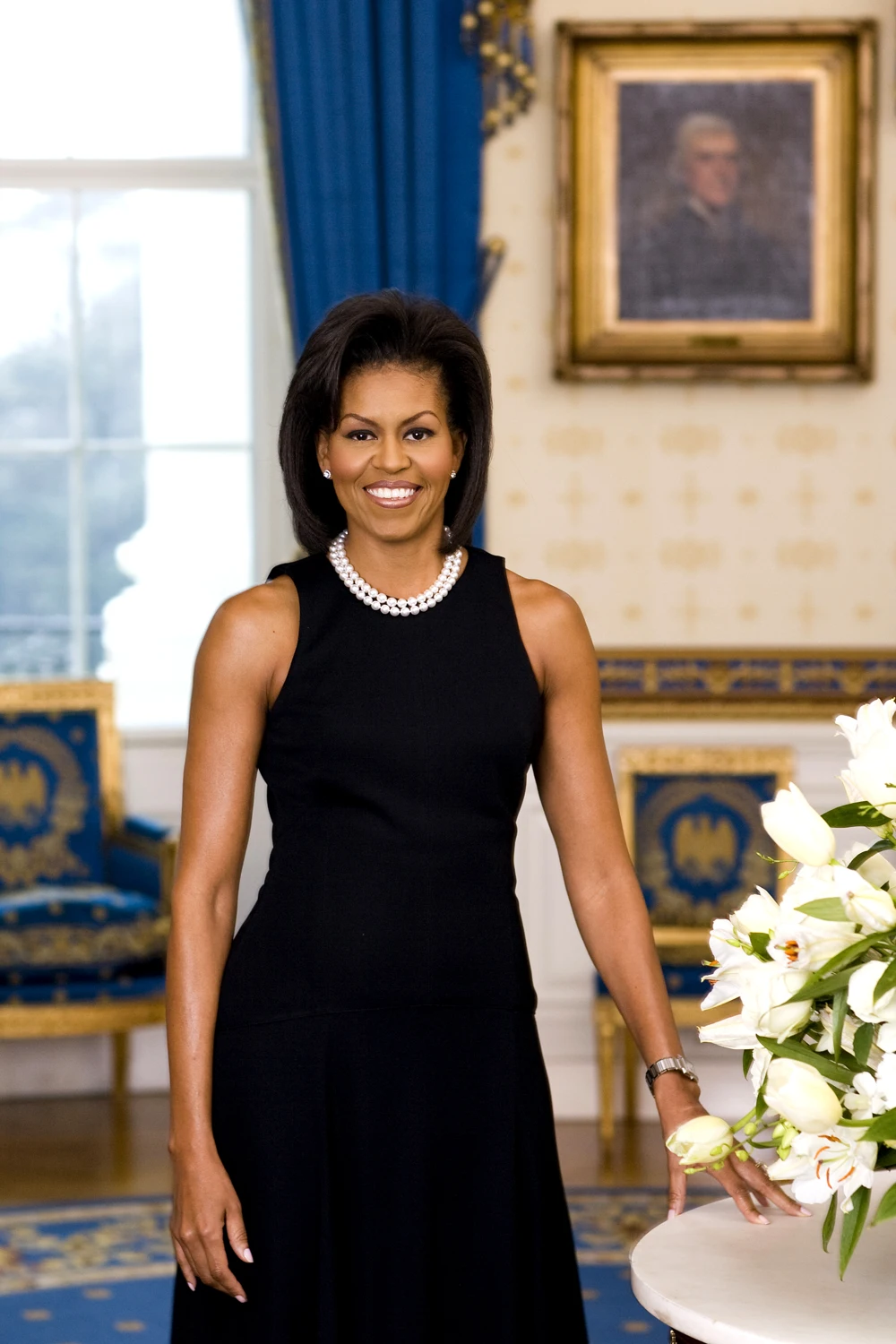
Joyce Boghosian / White House; public domain. Image source Public domain — U.S. federal government work

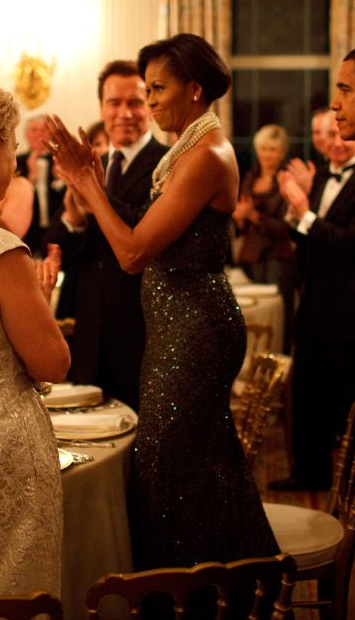
Pete Souza / White House; public domain Image source Public domain — U.S. federal government work

At the White House Governors Ball on 22 February 2009, Obama wears black again, but the necklace changes the picture. The presidential library identifies the occasion and the State Dining Room setting. Obama Presidential Library In this photograph she is standing sideways and applauding, surrounded by other guests. A strapless, sparkling gown leaves her shoulders bare; several pale rows gather high around the neck and descend over the upper chest. Against the official portrait’s compact double curve, this arrangement looks fuller and more theatrical. The dress supplies its own scattered points of light, so the necklace does not have to carry all the evening’s sparkle. This is a formal look, with room around the shoulders for a substantial necklace. If you enjoy layered strands, the useful detail is the gap between their lowest edge and the top of the dress. Try that relationship in motion, too: the photograph catches a woman clapping, not standing motionless for a jewellery display.
Try the neckline before you borrow the look
The two portrait details make a useful dressing-room comparison. Harris’s spaced pearls travel across visible skin on several fine, dipping lines; Obama’s closely set strands form a denser curve at the top of a dark dress. Begin with a garment already in your wardrobe and decide which of those drawings you want to see. With an open jacket and a lower-cut top, a chain with separated pearls can occupy the space between the lapels. With a simple round neckline, a shorter, closely strung necklace can echo the curve. Put the outfit on rather than judging the pieces separately on a table. Turn your head, raise your arms, sit down: the best-looking arrangement in a still photograph may shift when you move. Then step back to see the whole figure, including sleeves, shoes and any other jewellery. Thatcher’s brooch and bracelet, Harris’s trainers and Obama’s sleeveless dress all remind us how much a necklace shares its work with the rest of an outfit. There is room to borrow a proportion while keeping your own favourite clothes.
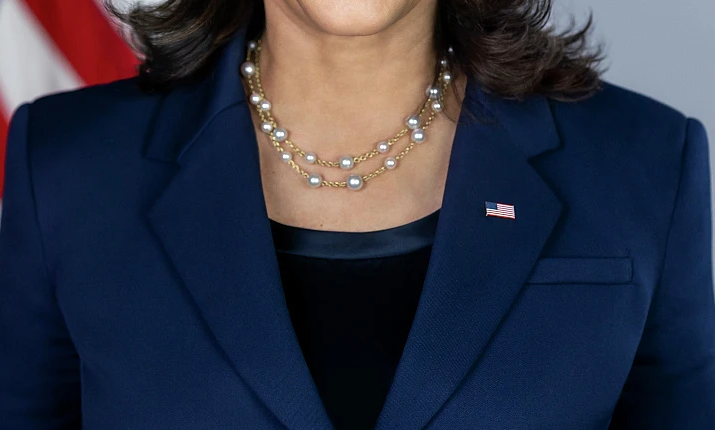
Lawrence Jackson / White House; public domain. Image source Public domain — U.S. federal government work
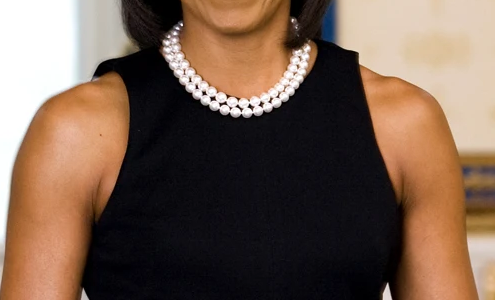
Joyce Boghosian / White House; public domain. Image source Public domain — U.S. federal government work
Questions readers may ask
Sources
- Margaret Thatcher Foundation, BBC1 My Favourite Things interview, Russell Harty; recorded 7 January 1987.
- Margaret Thatcher Foundation, Interview for Vogue, Ingrid Bleichroeder; interviewed 6 August 1985, published October 1985.
- Estate of Yousuf Karsh, Margaret Thatcher, 1976.
- Alpha Kappa Alpha Sorority, Incorporated, Our History.
- Isis Davis-Marks; updated by Kayla Randall, Discover the Special Meaning Behind Kamala Harris’ Pearls, Smithsonian Magazine, 2021; updated 2024.
- Janelle Okwodu, Kamala Harris’s Vogue Cover Is a Tribute to Her Sorority Days, 10 January 2021.
- U.S. National Archives, Selected Vice Presidential Records.
- Joyce Boghosian / White House; Wikimedia Commons, Michelle Obama official portrait, 2009.
- Michelle Obama, Excerpt from Becoming: her White House style, ELLE, 12 November 2018.
- Barack Obama Presidential Library, First Lady Michelle Obama gallery, Governors Ball, 22 February 2009, image P022209PS-0150.
Card image credits
- Featured card: Lawrence Jackson / White House; public domain. Image source Public domain — U.S. federal government work
- Article card: Lawrence Jackson / White House; public domain. Cropped card detail. Image source Public domain — U.S. federal government work
Hazelnut Select Studio is a Vancouver studio specialising in saltwater cultured pearls — Akoya, South Sea Gold and White, Black Tahitian and Keshi. Pearls are selected and matched in Japan; pieces with a certificate carry one issued by Pearl Science Laboratory, Tokyo. Viewings are in Vancouver, in person and by appointment.