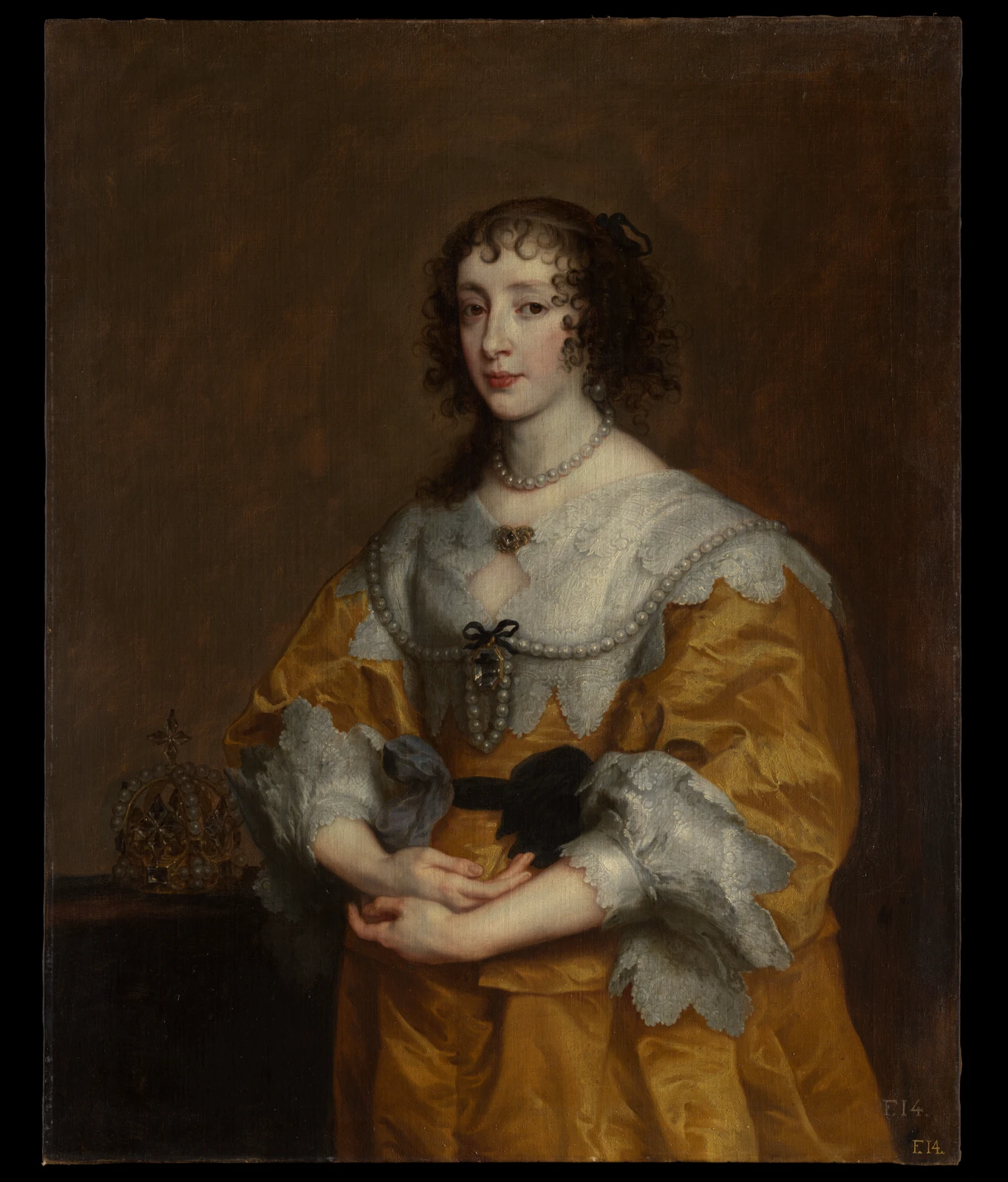
The Metropolitan Museum of Art, Bequest of Mrs. Charles Wrightsman in honor of Annette de la Renta, 2019; 2019.141.10. Public Domain. Image source Public Domain / Met Open Access
The Metropolitan Museum of Art, Bequest of Mrs. Charles Wrightsman in honor of Annette de la Renta, 2019; 2019.141.10. Public Domain. Image source Public Domain / Met Open Access
The Metropolitan Museum of Art, Bequest of Mrs. Charles Wrightsman in honor of Annette de la Renta, 2019; 2019.141.10. Public Domain. Image source Public Domain / Met Open Access
Royal Pearls on the Move: Gifts, Detachable Drops and a Change of Dress
A painted gift, detachable pendants and two very different necklace lengths: royal pearls through the objects and people who wore them.
Royal pearl stories become more vivid when we follow how objects are given, rearranged and worn. Henrietta Maria sent a painted likeness as a diplomatic gift; Elizabeth received named necklaces for her 1947 wedding; Denmark's Pearl Poire necklace supplied detachable earring drops; Rambhai Barni's photographs show different lengths within a changing wardrobe.
A queen sends her portrait
The Metropolitan Museum of Art, Bequest of Mrs. Charles Wrightsman in honor of Annette de la Renta, 2019; 2019.141.10. Public Domain. Museum source Public Domain / Met Open Access
The crown has its own place beside Henrietta Maria. The pearls seem to be everywhere else: at her throat, beside her face, across her shoulders, falling towards the centre of her dress. In Anthony van Dyck's 1636 portrait, they give the eye several routes through an otherwise imposing royal appearance. The painting itself had a destination. The queen commissioned it for Cardinal Francesco Barberini, according to the Metropolitan Museum of Art. A recipient could encounter her likeness, her ornaments and that conspicuous crown together. The gift carried the image of a richly dressed queen without requiring the jewellery in the picture to make the journey.
Look closely at the little interruptions in all that pale brilliance. The short necklace follows the neck; the longer drape crosses the upper dress before gathering into a loop. A dark bow and its jewel break the line near the centre. Beside the face, pale drops emerge from dark curls. Each part has a different background, which helps the arrangement stay readable even among gold-coloured cloth and white lace. Let your eye move from the queen's presence to the ornaments and the separate places they occupy. There is more to this lavish look than simply adding another strand.
Two old names at a new wedding
The Queen Anne and Queen Caroline necklaces arrived at Princess Elizabeth's wedding with histories already attached to their names. Royal Collection Trust records that her parents gave them to her and that she wore them on her wedding day in 1947; the older ownership associations come through Queen Victoria's inventory. Those few details, recorded in the exhibition labels, are enough to change the way a necklace reads. Alongside a wedding dress, it becomes a family gift with a public past. The wedding adds another wearer and another occasion to an object that already belongs in a collection's memory.
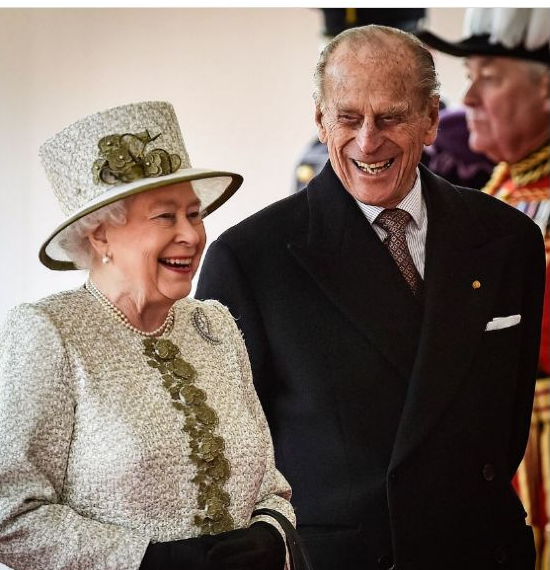
Source-page screenshot for editorial reference; not a Hazelnut product photograph or endorsement.
PA; source @princeandprincessofwales, Instagram. Public-page screenshot. Image source
The later photograph shown here offers a different kind of closeness: Elizabeth II and Prince Philip laughing together, her short pale necklace framed by a light, textured coat and its green-toned decoration. The necklace stays near the neck rather than following the coat's central line. A brooch occupies another patch of the upper garment, and the hat repeats the outfit's pale and green colours. This is a later wearing comparison, not a photograph of the 1947 wedding. The gift history comes from the collection record; the picture gives us the Queen's pearl wearing in another setting, with the jewellery visible as part of the whole outfit.
Five drops, and a tiara with its own route
In Denmark's Pearl Poire suite, look first at the necklace and the two earrings laid beside it. The necklace carries three large hanging drops along its lower curve. The separate earrings repeat the pear-shaped form, making the relationship unusually easy to see in this object photograph. The Danish Royal House supplies the satisfying piece of construction history: two of the necklace's five pendants could become earrings. The necklace was the Egyptian khedive's wedding gift to Lovisa in 1869. A gift intended for one place on the body could help furnish another.
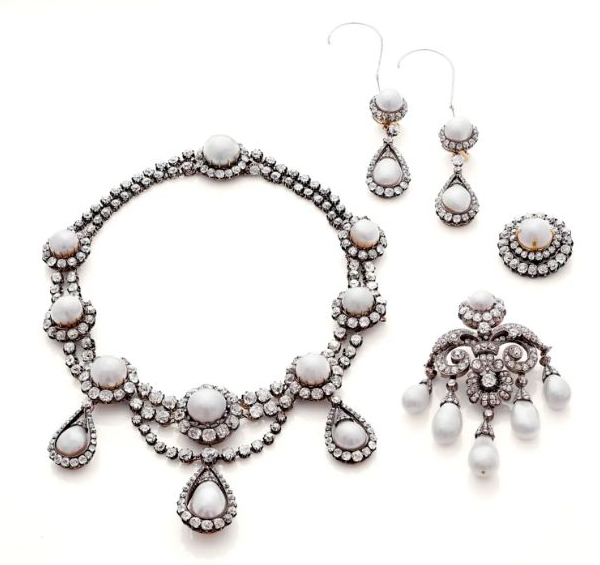
Source-page screenshot for editorial reference; not a Hazelnut product photograph or endorsement.
Iben Kaufmann ©; Danish Royal House. Public-page screenshot. Image source
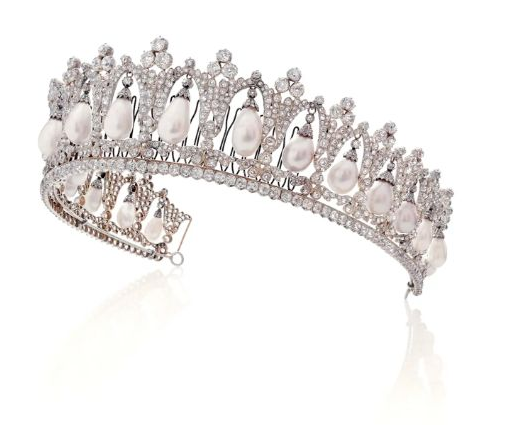
Source-page screenshot for editorial reference; not a Hazelnut product photograph or endorsement.
Iben Kaufmann ©; Danish Royal House. Public-page screenshot. Image source
The tiara takes the same pear-shaped form above the face. The Danish Royal House's account describes eighteen pearl drops suspended from diamond-set arches and traces its passage through Princess Louise of the Netherlands (1808–1871) to her granddaughter Lovisa of Sweden, who married the future Frederik VIII of Denmark. In the object photograph, the curved base and the spaces between the arches are visible along with the hanging forms. Place this view beside the necklace and earrings, and the family resemblance becomes clear without all the pieces being identical. The necklace gathers its large drops along a lower curve; the tiara suspends them around an open structure. The suite brings together objects with different journeys and different jobs to do.
Rambhai Barni: a long line through a dress
A photograph in Rambhai Barni Rajabhat University's historical account shows the future queen during the period the university places in France, 1920–24. In the left-hand image, a fine pale strand runs down a sleeveless dress towards the hand held near her waist. The dress has a long, quiet upper section before the skirt gathers into bands of decoration. The strand travels through that quieter area, so its length remains easy to follow. Next to it, the university presents another photograph in a different dress and interior. Together they make a welcome change of scale after the Danish set: a necklace becomes part of the length and movement of an entire outfit.
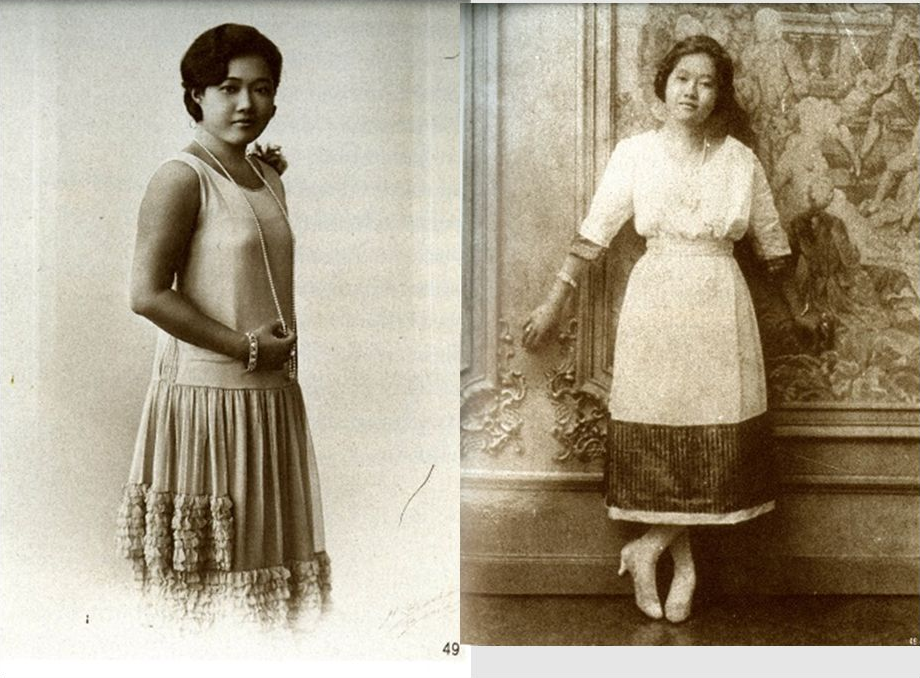
Source-page screenshot for editorial reference; not a Hazelnut product photograph or endorsement.
Rambhai Barni Rajabhat University; photographer unverified. Public-page screenshot. Image source
Thailand's International Studies Center describes Rambhai Barni's use of short and long pearl necklaces, including a strand knotted at the chest, in its study of royal attire and foreign relations. The long strand visible here gives that discussion a tangible starting point, although it does not show the chest knot described elsewhere. Notice how much of the effect comes from the dress: the open arms, the relatively plain bodice, the lower skirt's busier surface. A different neckline or a sash across the chest would give the same length another set of neighbours.
A shorter necklace, a different centre of attention
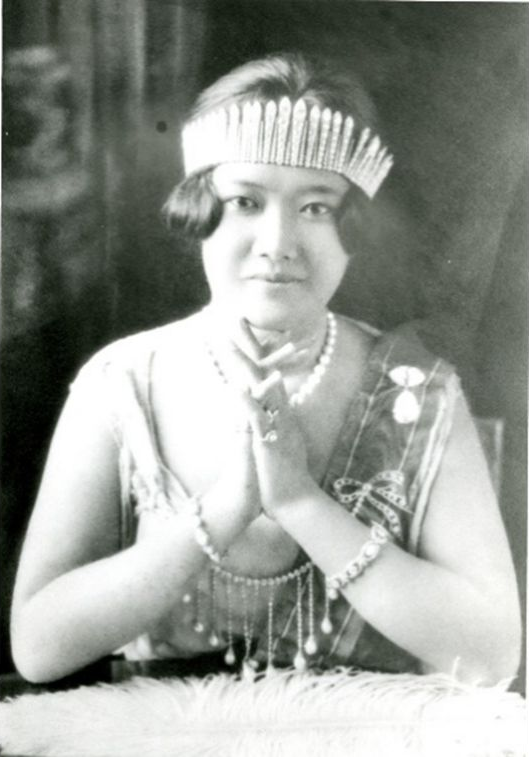
Source-page screenshot for editorial reference; not a Hazelnut product photograph or endorsement.
Rambhai Barni Rajabhat University; photographer unverified. Public-page screenshot. Image source
Another university portrait, placed in its account of European travel in 1934, draws the jewellery much closer to the face. A short pale necklace circles the neck; the raised hands bring wrist ornaments into the same small area. Above them is a tall, repeated head ornament. The composition is compact enough that necklace, fingers, bracelets and face can be read together. Here the wrist jewellery is gathered near the face, rather than appearing as a glint at the edge of a full-length portrait. It helps explain why a short strand can belong in an elaborate appearance without having to supply all the decoration itself.
Return to the longer strand in the earlier photograph and the difference is striking. One arrangement stretches the eye down the dress; the other gathers it around the face and hands. This is where the pleasure of royal pearl collections becomes more immediate than their inventories. A painted likeness can travel as a gift. A pendant can move from a necklace to an earring. A change of dress can invite a shorter line. The objects retain their histories, but the photographs leave us with something active to look at: people finding places to wear them.
Questions about these royal pearls
Sources
- The Metropolitan Museum of Art, Queen Henrietta Maria, Anthony van Dyck, 1636.
- Royal Collection Trust, Queen Elizabeth II: Her Life in Style — Large text labels, PDF page 28, necklace labels.
- The Royal House of Denmark, The Pearl Poire set.
- The Royal House of Denmark, Perlediademet, 21 September 2020.
- International Studies Center, Ministry of Foreign Affairs, Thailand, พัสตราภรณ์กับการต่างประเทศไทยสมัยใหม่, 2023, pp. 70, 75–76.
- Rambhai Barni Rajabhat University, historical timeline, France 1920–24 and European travel 1934 contexts.
- @princeandprincessofwales, later Elizabeth II and Prince Philip photograph, posted 20 November 2019; original caption credits PA; photograph date unverified.
Card image credits
- Featured card: The Metropolitan Museum of Art, Bequest of Mrs. Charles Wrightsman in honor of Annette de la Renta, 2019; 2019.141.10. Public Domain. Image source Public Domain / Met Open Access
- Article card: The Metropolitan Museum of Art, Bequest of Mrs. Charles Wrightsman in honor of Annette de la Renta, 2019; 2019.141.10. Public Domain. Cropped card detail. Image source Public Domain / Met Open Access
Hazelnut Select Studio is a Vancouver studio specialising in saltwater cultured pearls — Akoya, South Sea Gold and White, Black Tahitian and Keshi. Pearls are selected and matched in Japan; pieces with a certificate carry one issued by Pearl Science Laboratory, Tokyo. Viewings are in Vancouver, in person and by appointment.