Understanding pearl reports
What does a pearl report tell you? Explore common sections, from pearl type and measurements to test findings, using documents from Pearl Science Laboratory as examples.
Start with the object described, then explore the relevant sections. The photograph, measurements and report type help put the findings in context.
| 1 · Formation | When reading the formation entry, go by the report's specific explanation. Do not judge the finding simply by how round the pearl looks. |
|---|---|
| 2 · Nacre integrity | Read nacre integrity together with what the report records. Looking at a pearl cannot stand in for the test result. |
| 3 · Absence of damage | Check what the report records about damage, and look at the surface of the pearls themselves when you view them. If anything is unclear, ask. |
| 4 · Nacre | A nacre entry may be given as a figure or as a test result. Read it the way it is written on that report. |
| 5 · Bead nucleus | For findings about the bead nucleus, go by the report. A photograph of the surface cannot tell you what is inside the pearl. |
| 6 · Processing | Read processing-related entries together with the report's explanation. When you view or try on a piece, you can also ask about the details around the drill holes and the settings. |
| 7 · Colour treatment | If the report touches on colour treatment, read the wording and the explanation closely. Colour that looks natural is not a substitute for the test finding. |
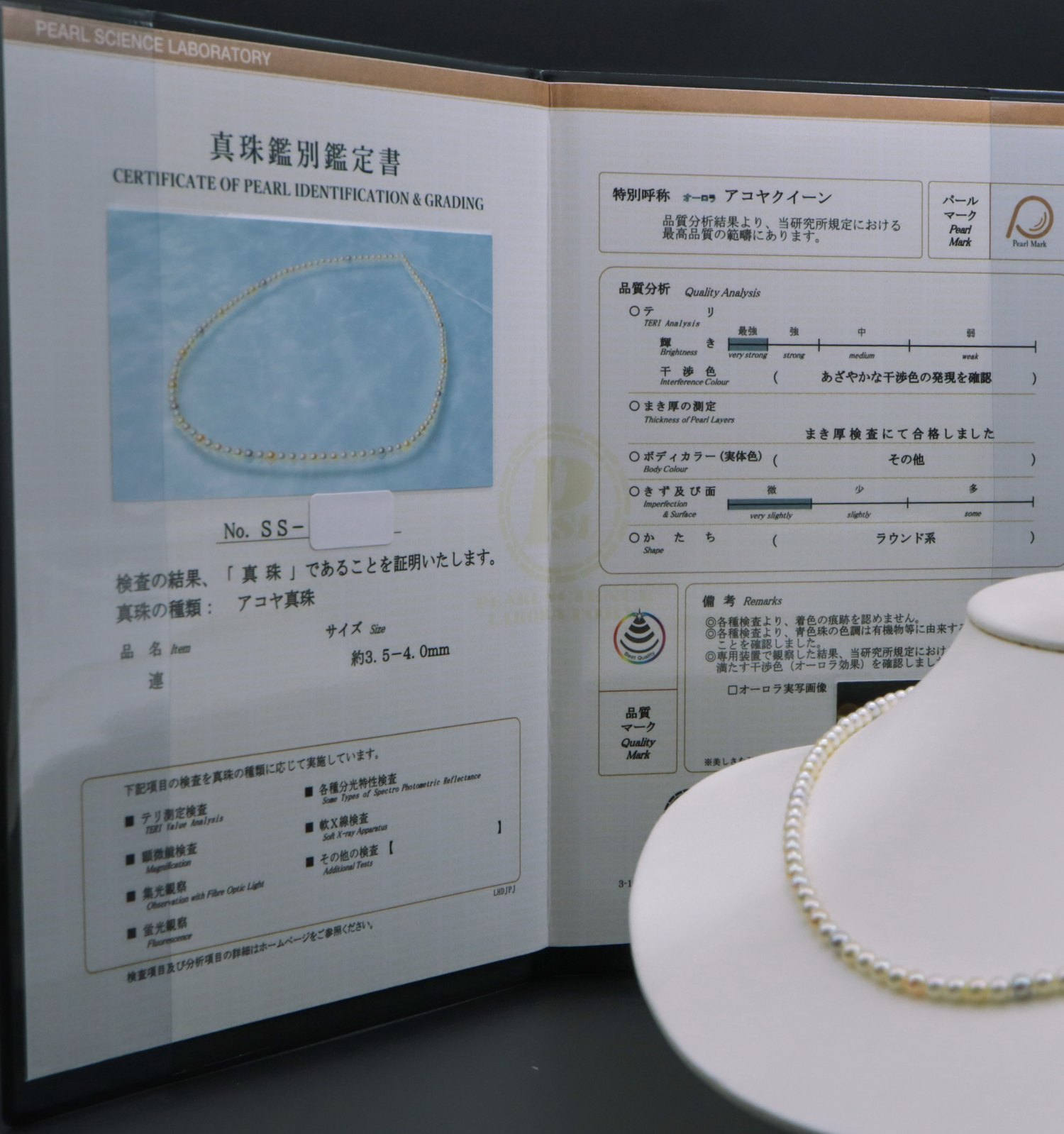
A photographed certificate from Japan’s Pearl Science Laboratory
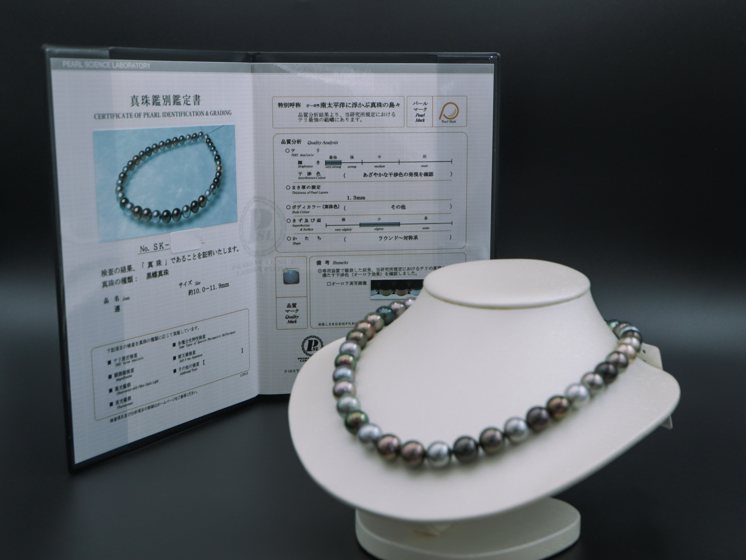
Pearls and a certificate shown together as an example
| Certificate number | Each certificate has its own number. As you look, check whether the number, the photograph on the certificate and the recorded size correspond to the pearl in front of you. |
|---|---|
| Identification result | This field states the conclusion reached through examination. The Japanese word 真珠 means “pearl”; it does not mean a natural pearl that was not cultured. |
| Pearl type | This field gives the type of pearl. For example, アコヤ真珠 means an Akoya pearl. |
| Size | Size is usually marked in millimetres, and a strand may list a range of sizes. It can help you picture the scale, but a larger pearl does not mean its other qualities are necessarily better. |
| Special designation | Some reports carry a special designation — a name the issuing laboratory uses in specific circumstances. What it means has to be read against that laboratory's own explanation. |
| Lustre · TERI | TERI is used to describe a pearl's lustre. When you read this field, note how the certificate records it: grading scales differ between laboratories, and they are not always directly interchangeable. |
| Interference colour (iridescence) | The pinks, greens and other colours that seem to float on a pearl, sometimes shifting as the angle changes. They are best looked at slowly, under different light, and compared with what the certificate describes. |
| Nacre thickness · まき厚 | まき厚 relates to nacre thickness. If the certificate lists a figure, you can read the thickness from it. If it gives only a test result, read it as that result. |
| Body colour | Body colour is a pearl's own underlying colour. It is different from the iridescence that floats on the surface. When you are choosing, it helps to look at both. |
| Surface and blemishes | Read this field with the pearls in front of you. Where are the small surface marks? How noticeable are they up close — and once the piece is worn? Those details help you decide how much they matter to you. |
| Shape | Round, near-round and irregular pearls each look different. The certificate records the shape; the pearl itself shows you its outline and its character. |
The certificate also lists the methods and instruments used in testing. If you are curious about how a particular finding was reached, this is the column to follow up.
Start with the report type
Different reports focus on different characteristics. Identify the document and report type first, then explore its findings and explanations.
| Type SP | When reading a Type SP report, go by the test items the report actually lists, and by the laboratory's own explanation of them. |
|---|---|
| Type SS | Read a Type SS certificate against the fields on the report itself. What the different items record is not something to judge from the name on the cover alone. |
| Type SK | On a Type SK certificate, start with the pearl type, the size and the test results listed, then compare them with the pearls themselves. |
| Type SJ | What a Type SJ certificate records is what is on that report. If a term is unfamiliar, check the issuing laboratory's explanation. |
| Type FA | With a Type FA certificate, look at the identification result first, then check whether the report lists any quality-related items as well. |
Names, marks and findings
Report names, quality marks and individual findings serve different purposes. Reading them within their sections makes the information easier to follow.
Read the documents, then look at the pearls. Consider the findings alongside the lustre, colour and appearance of the piece when worn.
| Top Quality mark | This mark corresponds to a set of quality conditions set by the laboratory. The conditions are as the laboratory states them. When you see the mark, read it together with the other entries on the certificate. |
|---|---|
| Strongest Lustre mark | The conditions for the Strongest Lustre designation are as the issuing laboratory states them, and they do not convert directly to another laboratory's grades. |
| Lustre mark | When reading a Lustre mark, look at the lustre entry on the report as well. What the mark means is defined by the issuing laboratory's explanation. |
A certificate is there to help you choose. Once you have finished with what is on paper, come back to the pearls themselves — their lustre, their colour, how they feel on you — and whether they are right for your own eye.
Viewings not yet available