Photograph supplied by Hazelnut Select Studio; report issued by Pearl Science Laboratory. Partially obscured as supplied.
Photograph supplied by Hazelnut Select Studio; report issued by Pearl Science Laboratory. Partially obscured as supplied.
Photograph supplied by Hazelnut Select Studio; report issued by Pearl Science Laboratory. Partially obscured as supplied.
How to Read a Pearl Certificate Without Asking It to Prove Too Much
Read a real SS/Aurora Akoya Queen report, distinguish seven current PSL forms, and separate laboratory findings from assumptions about origin and stock.
Read a pearl report in three layers: which item it describes, what examination it records, and what its conclusions actually say. Then check the report’s form and terminology with the issuing laboratory. In the real example below, “thickness examination passed” is not a numerical thickness, and an SS report is not automatically an Aurora Hanadama report. A Japanese issuer is not, by itself, evidence that the pearls grew in Japan.
Begin with the pearl, not the impressive word
A pearl certificate can look reassuring before you have understood a line of it. There is a laboratory name, a photograph, several scales and perhaps an attractive special designation. The danger is not that these details are meaningless. It is that they can be made to answer questions they were never intended to answer.
“Which pearl is this?” and “How was its quality assessed?” are different questions. So are “Where was it examined?” and “Where was it grown?” A useful reading keeps those questions separate long enough to connect each answer to its evidence.
Here we use a photograph supplied by Hazelnut Select Studio of a report from 真珠科学研究所, which uses the English name Pearl Science Laboratory, or PSL. It is an opportunity to practise reading, not an independent authentication of the document or of every pearl sold by the studio. Part of the number is covered, and a jewellery display obscures some remarks. Those limitations matter as much as the words we can see.
A real SS report: what is actually visible?
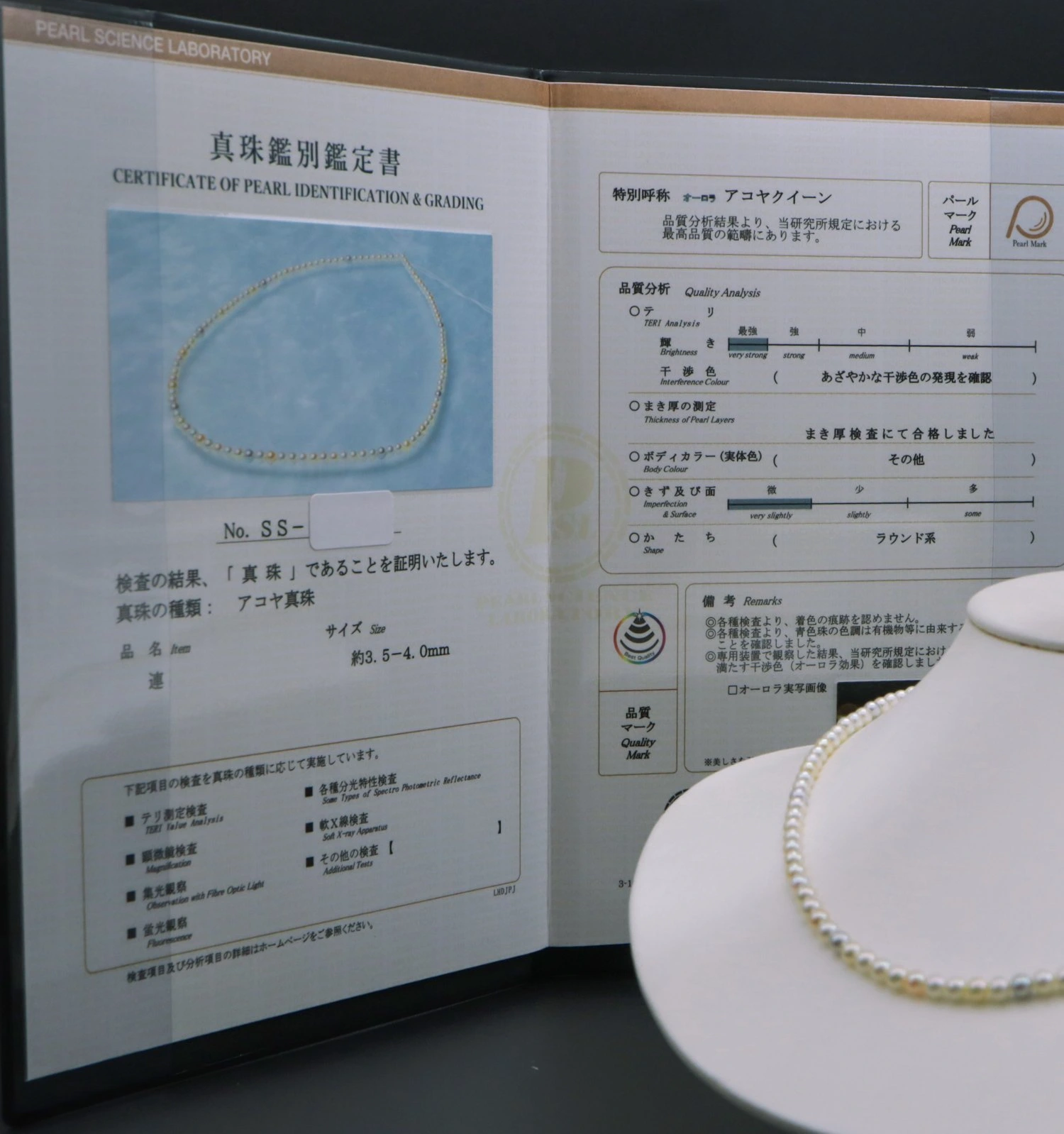
Photograph supplied by Hazelnut Select Studio; report issued by Pearl Science Laboratory. Partially obscured as supplied.
Start on the left, where the document identifies its subject. The visible number begins SS-. The pearl type is Akoya; the item is a strand; the stated size is approximately 3.5–4.0 mm. The report includes a photograph of a strand. These details establish the description we are reading, not the identity of any necklace that happens to be nearby.
That last distinction is easy to overlook in a beautiful product photograph. Imagine, for example, that a page showed this report next to an 8 mm necklace. Both could be attractive Akoya strands, but the visible size range would not explain that pairing. You would need evidence connecting that particular item to its own report. This is a hypothetical mismatch, not a claim that the supplied photograph contains one.
The right page carries Aurora Akoya Queen, not Aurora Hanadama. It also contains separate fields for TERI, pearl-layer thickness, body colour, surface and shape. Reading these separately is more informative than reducing the whole page to “top grade.”
Three details are especially instructive:
- The thickness result is a pass, not a number. The visible line says that the pearl-layer thickness examination was passed. It does not print a millimetre measurement there. We cannot turn that result into “0.4 mm,” “0.6 mm” or any other invented figure.
- The shape wording is a round category. It does not say that every pearl is a mathematically perfect sphere. Similarly, the surface scale should not be paraphrased as “absolutely flawless.” A category is not permission to strengthen the laboratory’s wording.
- A visible remark addresses colouring. The first readable remark records that the tests did not detect traces of colouring. That is narrower than “no treatment of any kind,” and much narrower than “everything this business sells is untreated.” The following remarks are partly obstructed; we do not fill them in from another report.
The body-colour field is an “other” category. That does not mean the pearl has no colour, nor does it invite us to rename its colour from a phone screen. It means the document uses that category. Sometimes accurate reading requires resisting a more appealing translation.
Seven current forms—not one alphabetic ladder
PSL currently lists seven forms:
| Form | Main scope |
|---|---|
| SP | Aurora Ten-nyo |
| SS | Highest-quality series |
| SQ | Premium Best TERI series |
| SK | Five-part quality analysis |
| SJ | TERI-focused analysis |
| FA | Identification, without a grade |
| FC | Identification, without a grade, plus nacre thickness |
The point of the table is not to memorize seven codes. It is to see that scope changes. A form focused on one characteristic and a form containing broader analysis are not interchangeable descriptions of the same examination. A report without a grade is not a declaration that the pearl is poor quality; it simply does not provide that grading conclusion.
PSL’s Chinese page still lists five; the language versions are not synchronized. Reading Chinese is not the problem; treating an older translation as a complete account of the current service is.
Nor should these letters be converted into an invented universal hierarchy—“SS equals AAAA,” for example. The useful comparison is the actual examination and conclusion in the issuing laboratory’s system, not an alphabet borrowed from another seller.
Pearl Mark, quality mark and special designation do different jobs
PSL separates Pearl Mark from Best Quality, Best TERI and TERI marks. Its English Pearl Mark list has seven conditions; Japanese lists six plus whole-surface nacre. PSL certification
For a reader, the important habit is to locate the label before interpreting it. Is this the form code, a mark, a named designation, or a measured or observed result? “Aurora Akoya Queen” sits in the special-designation area of our example. The thickness result sits elsewhere. One cannot stand in for the other.
Think of the report as an organized argument rather than a single sticker. The identification says what is being described; the analytical fields record particular findings; the designation expresses a conclusion within that laboratory’s framework. Collapsing them into one adjective throws away the most useful information on the page.
Why you should not borrow Hanadama’s number
A common reading error is to find a clear numerical rule elsewhere and paste it onto a report that does not show that number.
PSL’s separate Aurora Hanadama explanation specifies white Akoya pearls of at least 6 mm and a nacre thickness threshold of 0.4 mm, among other requirements. Our photographed document says approximately 3.5–4.0 mm and Aurora Akoya Queen. It is not an example of that Hanadama definition.
The lesson is not that small pearls need an apology. It is that a rule belongs to the category for which it was stated. The attractive number found on a laboratory website cannot be transplanted into a different specimen’s result. In this photograph, the honest thickness reading remains: examination passed; numerical thickness not visible in that field.
This is also why “SS” should not automatically be read aloud as “Hanadama.” The document itself gives us a different named result. Follow the actual text rather than the name you expected to find.
What testing adds that a photograph cannot
A photograph helps us see arrangement and appearance. It is not a substitute for looking inside a pearl or examining it under defined conditions.
GIA’s description of its own laboratory workflow provides a useful comparison: pearls are measured, examined with methods including X-radiography and spectroscopy, and assessed against reference materials under controlled lighting. This describes GIA’s process, not a claim that PSL follows every identical step. It shows why a laboratory conclusion can involve evidence unavailable in a retail photograph. GIA, “How GIA Identifies and Classifies Pearls”
PSL also explains that its aurora images are made under a particular lighting arrangement to examine interference-colour patterns. They are not ordinary outfit photographs or a promise that a necklace will look like its test image in every room. PSL, “オーロラ 花珠とは?”
For everyday viewing, this distinction is liberating. You do not need to reproduce a laboratory test at a café table. You can appreciate how a strand looks on you while recognizing that colour origin or internal structure requires a different kind of evidence. Beauty and identification are related concerns, not competing ones.
A report describes a particular item—not a whole business
The connection between report and specimen continues to matter after the terminology is understood. A photograph of a certificate cannot establish that a subsequently restrung necklace contains exactly the same pearls, or that every similar strand shares the findings.
SSEF’s explanation of its pearl reports makes the specificity tangible: when a cultured pearl occurs within a natural-pearl necklace, its position can be recorded by counting from the clasp. SSEF also explains that its report photograph is representational rather than an exact reproduction of colour or size. SSEF, “Pearls”
That example does not tell us anything about the composition of our Akoya strand. It illustrates why “a necklace has a report” is less precise than “this report describes these pearls.” The object, the description and the conclusion need to stay connected.
The same discipline applies to Japan-related claims. A Japanese laboratory’s name tells you about the issuer. Purchasing jewellery in Japan tells you about the transaction. Neither fact, by itself, identifies where the pearls were cultured. If geographical origin matters to you, it needs its own supporting evidence rather than a shortcut through the certificate’s language.
Read for an answer, not for reassurance alone
After reading this example, you can make a more useful statement than “it has a good certificate”: the photographed document describes an approximately 3.5–4.0 mm Akoya strand, carries an SS prefix and Aurora Akoya Queen designation, and shows particular findings whose scope should be preserved.
You can also name what remains outside the photograph: the concealed identifier, the obscured remarks, independent authentication and a verified match to a particular item offered today. Those are not reasons to dismiss the report. They are reasons not to ask it to prove more than the available evidence permits.
For a quicker side-by-side reading aid, use our certificate field guide. This article explains the logic; the guide helps you find your place on the page.
Questions about reading a pearl certificate
Sources
- Pearl Science Laboratory — “Pearl Identification and Quality Analysis”; current English service description.
- 真珠科学研究所 — “真珠鑑別・品質分析”; current Japanese service description and designation table.
- 真珠科学研究所 — “珍珠鉴定和质量分析”; older Chinese-language presentation, used only to explain the discrepancy.
- 真珠科学研究所 — “オーロラ 花珠とは?”.
- Gemological Institute of America — “How GIA Identifies and Classifies Pearls”.
- Swiss Gemmological Institute SSEF — “Pearls”.
- Hazelnut Select Studio — owner-supplied photograph of the SS/Aurora Akoya Queen report reproduced in this article; no public source URL.
Card image credits
- Featured card: Photograph supplied by Hazelnut Select Studio; report issued by Pearl Science Laboratory. Partially obscured as supplied.
- Article card: Hazelnut Select Studio; Pearl Science Laboratory report. Cropped card detail; original privacy masks retained.
Hazelnut Select Studio is a Vancouver studio specialising in saltwater cultured pearls — Akoya, South Sea Gold and White, Black Tahitian and Keshi. Pearls are selected and matched in Japan; pieces with a certificate carry one issued by Pearl Science Laboratory, Tokyo. Viewings are in Vancouver, in person and by appointment.