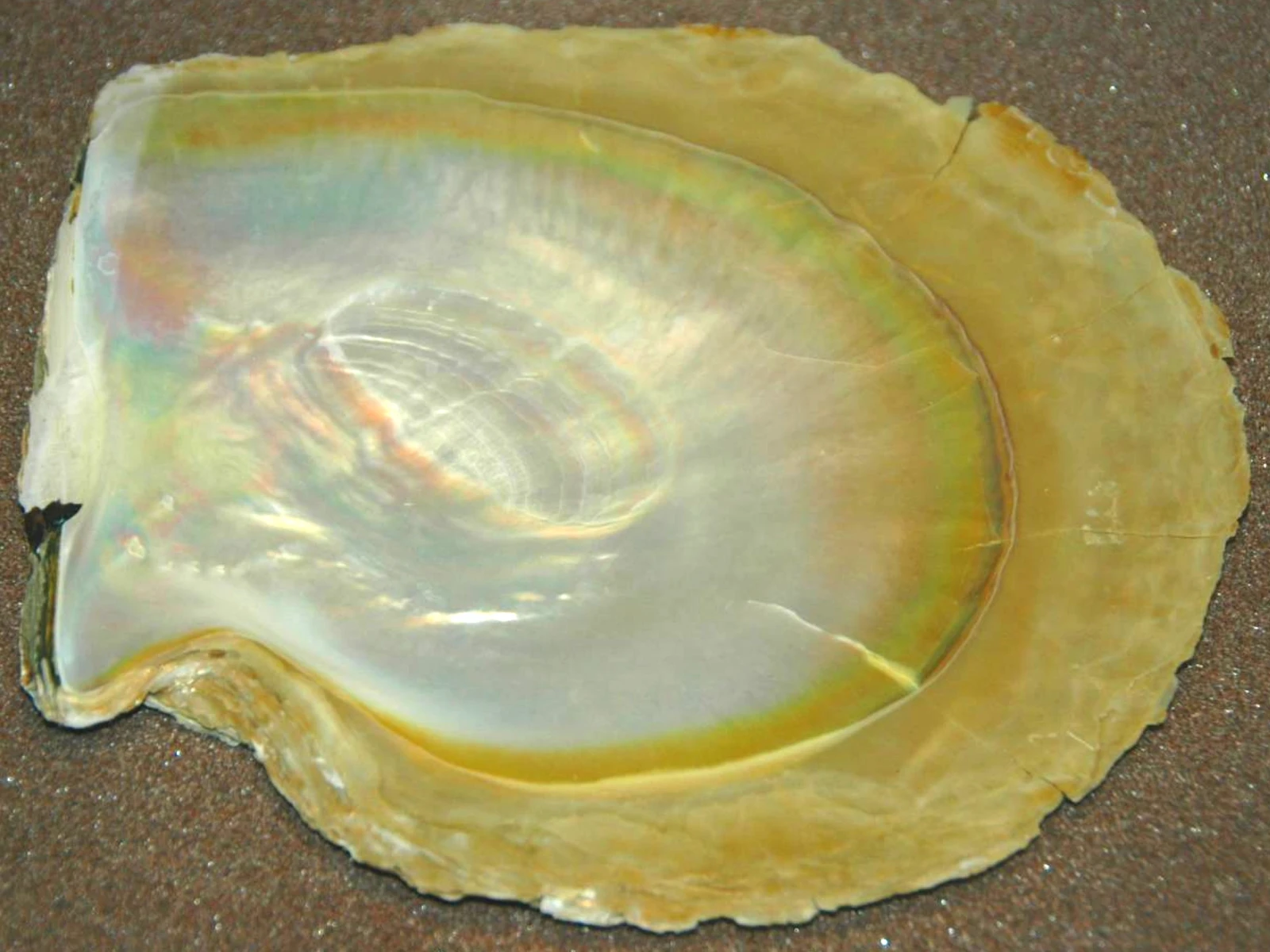
James St. John, Pinctada maxima (gold-lipped pearl oyster), Field Museum, Chicago, via Flickr / Wikimedia Commons. CC BY 2.0; resized, uncropped. Not Hazelnut inventory. Image source CC BY 2.0

James St. John, Pinctada maxima (gold-lipped pearl oyster), Field Museum, Chicago, via Flickr / Wikimedia Commons. CC BY 2.0; resized, uncropped. Not Hazelnut inventory. Image source CC BY 2.0
James St. John, Pinctada maxima (gold-lipped pearl oyster), Field Museum, Chicago, via Flickr / Wikimedia Commons. CC BY 2.0; resized, uncropped. Not Hazelnut inventory. Image source CC BY 2.0
Saltwater vs. Freshwater Pearls: A Difference in Habitat, Not a Quality Ranking
Separate habitat, cultivation and internal structure—then compare the actual pearls, not a presumed ranking.
Freshwater and saltwater describe growth environments, not quality grades. Cultured pearls are not imitations. Compare the actual pearls’ appearance and design; use appropriate identification evidence for claims about origin or structure rather than relying on colour or a sales label alone.
Two white pearl necklaces can look remarkably similar in a photograph. One is labelled freshwater, the other saltwater. It is tempting to treat those words as the beginning and end of the comparison: inexpensive versus precious, ordinary versus special, perhaps even imitation versus real.
That shortcut mixes together several different questions. The water in which a pearl grew is one question. Human involvement in its formation is another. Its internal structure, appearance and suitability for a particular piece of jewellery are others again. Separating them makes the comparison more useful—and considerably more interesting.
Start with three different questions
Freshwater or saltwater describes environment; natural or cultured describes human involvement in formation. Bead structure is another question. See GIA’s Pearl Description.
An easy way to keep the categories straight is to imagine three boxes on an identification record:
| Question | What the answer tells you | What it does not tell you alone |
|---|---|---|
| In what environment did it grow? | Freshwater or saltwater context | Whether its appearance is beautiful |
| Was formation initiated through cultivation? | Natural or cultured identity | Whether it contains an inserted bead |
| What is its internal structure? | The relevant structural findings | How well it matches the other pearls in a strand |
The table is a reading framework, not a home identification test. You cannot fill the boxes reliably by choosing whichever answer sounds more luxurious.
Cultured does not mean imitation. Once that distinction is clear, the comparison becomes more interesting: what do these particular pearls offer the person wearing them?
Why the two categories still look different in the market
GIA’s type overview describes freshwater mussels producing multiple pearls through tissue-initiated or bead-cultured methods.
Here is a compact guide to the variety a jewellery reader may encounter—not a grading chart:
| Group | Familiar appearances, not exclusive limits |
|---|---|
| Freshwater | White and pastel colours; varied shapes |
| Akoya | Familiar white or cream strands |
| South Sea | White, silver or golden pearls |
| Tahitian | Darker colours, sometimes colourful overtones |
See GIA’s type overview. Read the table as a starting point for looking, not as a set of boxes into which every necklace must fit. A category name should help you notice a piece, not stop you from noticing it.
You can use a category to narrow an exploration without making it a verdict. A reader drawn to the visual rhythm of small, matched white beads may start in one part of the market; someone who wants an irregular pink pendant may start elsewhere. Neither preference establishes a universal winner.
A bead is not the same thing as the pearl’s environment
“Does it have a bead?” is a useful question. It simply belongs in the structure box, rather than being treated as another way to ask where the pearl grew.
Think of environment and structure as coordinates rather than opposing teams. Knowing one coordinate does not automatically supply the other. Nor does the absence of a bead, considered alone, establish a natural origin.
This distinction matters when someone presents a cross-section as a sales argument. A cut specimen can reveal something about that specimen. It does not automatically represent all pearls from the same habitat, and it cannot rank their visible beauty on your behalf. A structural illustration needs an identified sample and a clear explanation of what is being shown.
Our separate article on bead and non-bead saltwater cultured pearls follows the growth mechanism and the exceptional cases in more detail. Here, the essential point is that “water type” is not a substitute for an internal description.
What scientists can read that a photograph cannot
The environment is more than a marketing label: it can leave measurable chemical clues. In a 2024 laboratory-methods paper, Ziyin Sun and colleagues explain that freshwater pearls typically have relatively higher manganese and lower strontium than saltwater pearls. Their example uses X-ray fluorescence measurements and reference data to distinguish the groups, while retaining an uncertain region requiring further examination. Gems & Gemology, “Chemical Analysis in the Gemological Laboratory”
The mechanism of the comparison is important. This is not a jeweller looking at a pink highlight and announcing “freshwater.” It is a comparison of elemental measurements with an analytical reference framework. The quantities being compared are not visible colours on a screen.
Nor should the explanation become a do-it-yourself recipe. A consumer cannot read manganese concentration from the warmth of a pearl’s colour, or infer a numerical threshold from the word “typically.” The example shows why identification may require an instrument; it does not make every instrument reading self-explanatory.
In practice, the strongest description keeps the observation and conclusion connected. “This looks pale pink” is a visual observation. “This formed in freshwater” is an identification claim. They may both be true, but the first sentence does not by itself prove the second.
Two pearls that refused to fit the usual boxes
Research also shows why a sensible distinction should not be turned into an infallible slogan. In a 2019 study, Nicholas Sturman and colleagues examined two unusually difficult pearls. Internal structures and chemical findings did not yield unanimous, definitive conclusions about natural versus cultured origin, growth environment or producing mollusk. The authors emphasized that such environmental ambiguity was very rare—not the normal state of pearl testing. “A Pearl Identification Challenge”
The value of this story is not that “nobody knows anything.” It is almost the opposite: careful researchers were willing to identify precisely where their evidence stopped. A claim of certainty would have made a shorter story, but a worse scientific one.
For a wearer, the practical lesson is proportion. Do not use an exceptional research case to distrust every routine identification. Equally, do not demand that every unfamiliar pearl obey a visual rule learned from a shopping chart. Good categories organize knowledge; they do not abolish unusual specimens.
Compare the pearls in front of you, not an imagined average
GIA evaluates pearl quality through size, shape, colour, lustre, surface, nacre and—where several pearls are used—matching. Those factors make more sense than treating habitat as a grade. GIA, “Pearl Quality Factors”
Consider a hypothetical pair of necklaces. One has a more regular outline, but a pearl near the centre catches your eye because it looks different from its neighbours. The other is deliberately irregular, with a consistent design rhythm. Which is better matched to its intended design? The answer cannot be obtained from “saltwater” or “freshwater” alone.
Or imagine two pairs of earrings. The larger pair makes the statement you wanted, but the smaller pair sits more comfortably with the rest of your jewellery. Size has changed the experience, not merely the price category. You are allowed to prefer the smaller pair without pretending it is physically larger or objectively rarer.
A useful visual comparison therefore keeps the conditions as consistent as possible: view the actual pieces together, at a similar distance and in the same light. This is a practical viewing method, not laboratory grading. It helps prevent a dramatic spotlight in one photograph from winning an argument against flat lighting in another.
The research photographs reproduced here show surface and reflection differences among Pinctada maxima cultured-pearl samples from one scientific study. They are not a freshwater-versus-saltwater beauty contest, a controlled retail comparison, or photographs of Hazelnut’s inventory. Their value is to make variation within a saltwater group visible. McDougall and colleagues, Figure 1
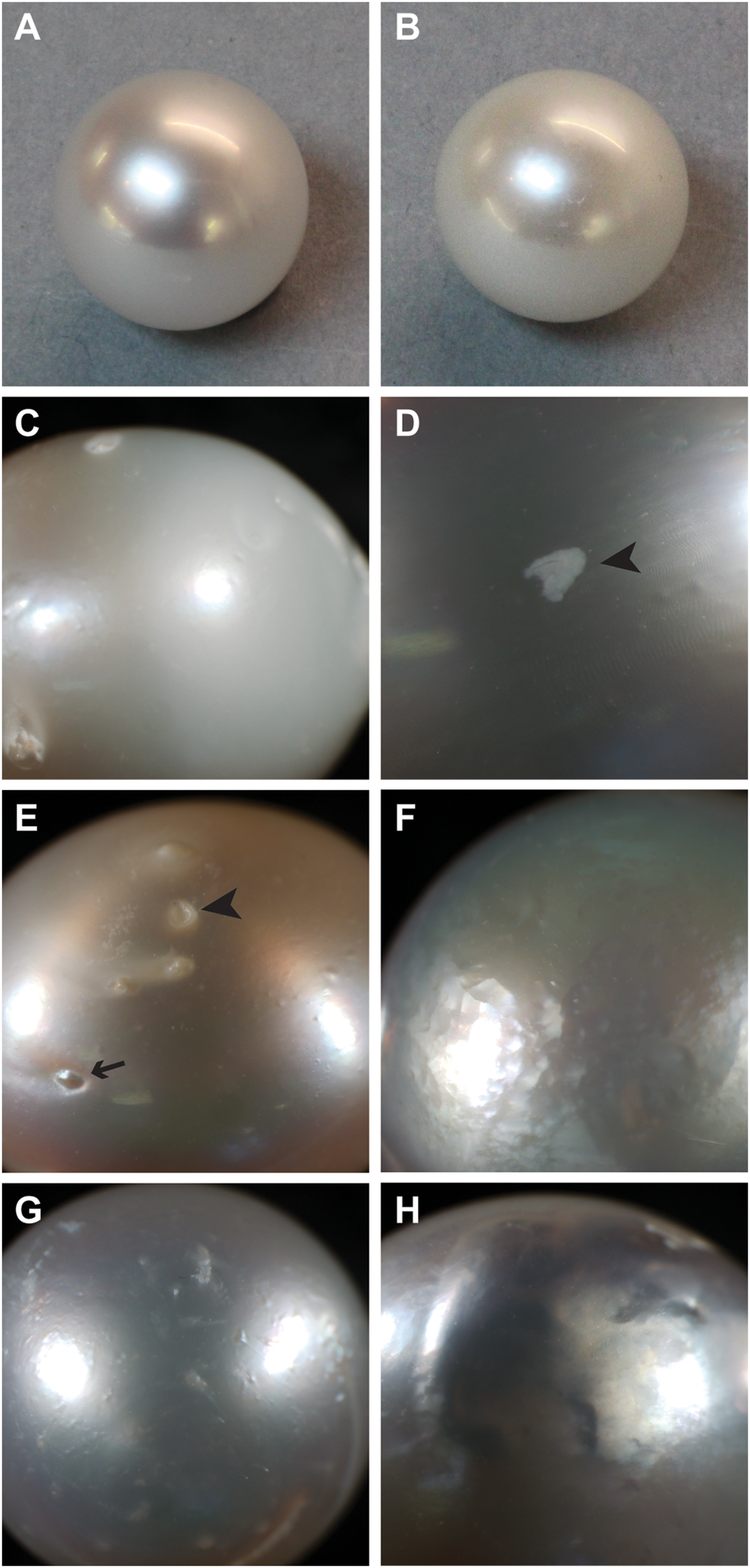
© 2021 McDougall, Aguilera, Shokoohmand, Moase and Degnan. Frontiers in Genetics 11:597459, Figure 1. CC BY 4.0. Original figure, unchanged. Image source CC BY 4.0
“More expensive” and “better for me” are different conclusions
It is reasonable to compare prices. It is less useful to expect the environment label to explain an entire jewellery price by itself. A finished piece also presents a particular arrangement of pearls, a setting, a clasp and a design. Comparing a loose pearl with a finished necklace is not comparing like with like.
Instead of beginning with “Which category wins?”, define the object you actually want: a compact pair of everyday studs, a long strand with movement, a substantial pendant or a closely matched short necklace. Then compare real candidates for that purpose. This keeps a general market category from overruling your own reason for buying.
No specific price, resale outcome or investment return follows from the distinctions in this article. The reward for understanding them is a clearer description of what you are considering—not a guarantee that one label will always cost more or last longer.
Both deserve pearl-appropriate care
Freshwater is not a synonym for indestructible, and saltwater is not a reason to neglect care. GIA advises avoiding ultrasonic and steam cleaning, protecting pearls from damaging chemicals, and wiping them with a soft clean cloth after wear. GIA, “Pearl Care and Cleaning”
The care routine belongs to the material, not to a hierarchy of prestige. A modestly priced piece that you enjoy often is worth caring for; an expensive label does not create a protective shield around the surface.
Once the categories are separated, the choice becomes less anxious. Identify what the pearl is, understand which observations support that description, and then give yourself permission to respond to the actual jewellery. Habitat tells part of its story. It does not decide your taste.
Questions about freshwater and saltwater pearls
Sources
- GIA, Pearl Description.
- Phoebe Shang / GIA, Freshwater Pearls vs. Saltwater Pearls: Understanding the Difference.
- Ziyin Sun, Michael Jollands and Aaron C. Palke, Chemical Analysis in the Gemological Laboratory: XRF and LA-ICP-MS, 2024; pearl-identification section and Figure 10.
- Nicholas Sturman and colleagues, A Pearl Identification Challenge, 2019.
- GIA, Pearl Quality Factors.
- Carmel McDougall and colleagues, Pearl Sac Gene Expression Profiles Associated With Pearl Attributes in the Silver-Lip Pearl Oyster, Pinctada maxima, 2021; Figure 1.
- GIA, Pearl Care and Cleaning Guide.
Card image credits
- Featured card: James St. John, Pinctada maxima (gold-lipped pearl oyster), Field Museum, Chicago, via Flickr / Wikimedia Commons. CC BY 2.0; resized, uncropped. Not Hazelnut inventory. Image source CC BY 2.0
- Article card: James St. John, Pinctada maxima (gold-lipped pearl oyster), Field Museum, Chicago, via Flickr / Wikimedia Commons. CC BY 2.0; resized, uncropped. Not Hazelnut inventory. Image source CC BY 2.0
Hazelnut Select Studio is a Vancouver studio specialising in saltwater cultured pearls — Akoya, South Sea Gold and White, Black Tahitian and Keshi. Pearls are selected and matched in Japan; pieces with a certificate carry one issued by Pearl Science Laboratory, Tokyo. Viewings are in Vancouver, in person and by appointment.