Published research specimens, not Hazelnut inventory. Photograph does not establish internal structure or grade. © 2015 Simon-Colin et al., Figure 6, Marine Drugs 13:3732–3744. CC BY 4.0. Full figure extracted from PDF; no specimen removed or retouched. Image source CC BY 4.0
Published research specimens, not Hazelnut inventory. Photograph does not establish internal structure or grade. © 2015 Simon-Colin et al., Figure 6, Marine Drugs 13:3732–3744. CC BY 4.0. Full figure extracted from PDF; no specimen removed or retouched. Image source CC BY 4.0
Published research specimens, not Hazelnut inventory. Photograph does not establish internal structure or grade. © 2015 Simon-Colin et al., Figure 6, Marine Drugs 13:3732–3744. CC BY 4.0. Full figure extracted from PDF; no specimen removed or retouched. Image source CC BY 4.0
Keshi Pearls: The Irregular Beauty—and the Limits of the Name
Here, Keshi refers to marine non-bead cultured pearls. It is not synonymous with natural pearl or baroque shape, and it does not guarantee a uniformly nacreous interior. The host context, individual appearance and strength of identification evidence still matter.
Here, Keshi refers to marine non-bead cultured pearls. It is not synonymous with natural pearl or baroque shape, and it does not guarantee a uniformly nacreous interior. The host context, individual appearance and strength of identification evidence still matter.
A pearl with a folded, almost petal-like outline seems to invite a story. It looks spontaneous, so perhaps it formed without human help. It has no obvious round centre, so perhaps it contains nothing but nacre. A seller calls it Keshi, so perhaps those two guesses are confirmed.
This is where a beautiful shape can get ahead of its evidence. Keshi is a useful pearl term, but not a miniature certificate. Its meaning becomes clearer when we separate the growth history, the mollusk that produced the pearl and the outline we happen to admire.
What Keshi means in a careful description
CIBJO’s 2026 definition places Keshi in marine non-bead culture, including intentional and accidental human intervention. Cultured is essential. CIBJO, section 5.106
That is a qualified definition, not a promise that every shop uses the word consistently. A responsible article should make its own usage explicit rather than pretending a trade word is perfectly controlled everywhere. Here, “Keshi” refers to this marine non-bead cultured context unless we are discussing a conflicting label.
Notice what the definition does not do. It does not assign a universal grade, name a particular colour or tell you which shape to prefer. The word gives the pearl a place in a formation story. Other evidence is needed for other questions.
This matters because “natural-looking” and “natural pearl” do very different work. The first can be a personal impression of an outline. The second is an origin claim. We can enjoy a form that feels unplanned without promoting that impression into gemmological identification.
Akoya, South Sea and Tahitian Keshi are contexts, not three grades
Keshi is not one mother-of-pearl species. The surrounding name matters. Published laboratory work discusses non-bead cultured pearls in the akoya, Pinctada maxima and Pinctada margaritifera contexts. These are useful branches for understanding what someone means, not three ascending quality levels.
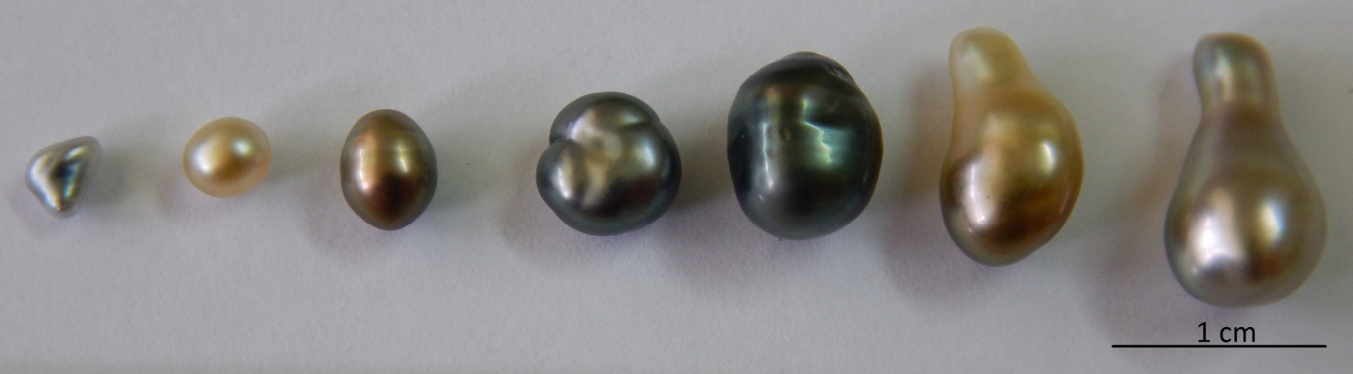
The photographed specimens in Figure 6 of a 2015 study are identified as Pinctada margaritifera Keshi. Their varied outlines make the connection between a named host and particular objects tangible. Simon-Colin and colleagues, Figure 6
Published research specimens, not Hazelnut inventory. Photograph does not establish internal structure or grade.
© 2015 Simon-Colin et al., Figure 6, Marine Drugs 13:3732–3744. CC BY 4.0. Full figure extracted from PDF; no specimen removed or retouched. Image source CC BY 4.0
Nor does a family name give every individual the same appearance. If your interest is a particular jewel, a broad category cannot stand in for looking at that pearl. The label and the object should keep enriching one another, not compete for your attention.
A useful mental picture is a set of intersecting questions rather than a ladder: marine or freshwater context; natural or cultured origin; bead or non-bead structure; then the particular mollusk and the visible form. Keshi belongs within that conversation. It is not a convenient way to skip it.
The accident story is not the whole story
The familiar account says that an oyster rejects an implanted bead but still produces a pearl. This can explain a non-bead cultured outcome, but it should not be turned into the only possible history of every Keshi.
The practical consequence is subtle. “Unplanned” may sound more romantic than “cultured,” but romance is not a reason to erase a production method. If the history of a particular pearl is unknown, it should remain unknown. A definition that allows more than one route does not identify which route happened in the object in front of us.
We need not make a pearl less interesting to make its description more accurate. In fact, the possibility of different growth paths is more intriguing than one story repeated for every specimen. Biology rarely owes a jewellery label a simple plot.
The baroque pearls that were not what the label implied
SSEF’s Laurent Cartier reported a revealing case: baroque pearls presented as Keshi were found by radiography to contain beads. The outside had encouraged one description; internal examination told a different story. Cartier, “New Beads in Cultured Pearls”
This is a particularly useful counterexample because it does not depend on a debate about taste. The pearls could still be appealing. What changed was the claim about their construction.
Baroque describes an irregular form; Keshi, in the usage explained here, describes a non-bead cultured context. Those descriptions can overlap, but one does not prove the other. Treating them as synonyms turns a visible feature into an invisible conclusion.
Imagine, hypothetically, two pendants with equally fluid outlines. One is correctly identified as non-bead cultured; the other contains a bead. The outlines might both work beautifully with a simple chain. Enjoying that resemblance does not require giving the pearls identical growth histories. This is a useful distinction for anyone who likes jewellery first and terminology second: accuracy does not take away the pleasure.
No bead does not mean a perfectly uniform interior
GIA examined 43 South Sea specimens and sanded five to expose cores. Australian provenance was supplier-reported. X-ray images showed light-grey-centred, seed-like, off-round and multiple organic-rich cores: distinct patterns, not identical interiors. Vaz, Alalawi and Belanke, GIA
PNAS research documented an organic centre, mineral growth and nacre in akoya Keshi. This specimen-specific sequence is not a universal interior recipe. Gim and colleagues, PNAS
The distinction is between absence of a bead and a full description of what remains. They are not equivalent. A short label cannot tell us the distribution of organic material, mineral regions or internal spaces in an individual pearl.
Sometimes the correct answer is deliberately qualified
In a 2024 GIA case, initial X-ray images of a button-shaped pearl showed an oval core, a radial pattern and an elongated feature resembling structures found in some bead-cultured pearls. Micro-CT then revealed two seed-like features within the concentric growth structure. The combined evidence supported a non-bead cultured interpretation; the authors called the akoya host most likely, not certain. Jayesh Surve and Abeer Al-Alawi, GIA
That little qualification deserves attention. It shows how an expert conclusion can be informative without pretending that every part of the identity is equally certain. An article should preserve the difference, not smooth it away to make a cleaner caption.
The interesting turn is that one internal feature did not settle the case. The investigators changed the view and read the features together. That is a much richer account of a Keshi than simply calling its outside “organic.”
Leave room for the pearl itself
Once the terminology is in place, we can stop asking the word Keshi to do everything. It need not prove that a pearl is rarer, better, entirely nacreous or untouched by human intervention before its shape is worth enjoying.
My editorial preference is to let an unusual outline remain visible rather than burying its interest beneath a long chain of prestige words. A description can simply identify what is supported and then draw attention to the actual object. The fascination is already there; an invented origin story is unnecessary.
If you want the biological explanation behind these distinctions, continue with how bead and non-bead saltwater cultured pearls grow. This article keeps the name in focus; that one follows the mechanism.
Questions about Keshi
Sources
- CIBJO, The Pearl Book, 2026; section 5.106.
- Nishka Vaz, Abeer Alalawi and Anukul Belanke / GIA, Diverse Range of Organic-Rich Cores in South Sea Non-Bead Cultured “Keshi” Pearls, 2026.
- Laurent E. Cartier / SSEF, New Beads in Cultured Pearls, originally published 2014.
- Jiseok Gim and colleagues, The mesoscale order of nacreous pearls, 2021.
- Jayesh Surve and Abeer Al-Alawi / GIA, Seed Features in an Akoya Keshi Pearl, 2024.
- Christelle Simon-Colin et al., Use of Natural Antimicrobial Peptides and Bacterial Biopolymers for Cultured Pearl Production, 2015; Figure 6. CC BY 4.0.
Card image credits
- Featured card: Published research specimens, not Hazelnut inventory. Photograph does not establish internal structure or grade. © 2015 Simon-Colin et al., Figure 6, Marine Drugs 13:3732–3744. CC BY 4.0. Full figure extracted from PDF; no specimen removed or retouched. Image source CC BY 4.0
- Article card: Published research specimens, not Hazelnut inventory. Photograph does not establish internal structure or grade. © 2015 Simon-Colin et al., Marine Drugs, Figure 6. Cropped two-specimen detail; CC BY 4.0. Image source CC BY 4.0
Hazelnut Select Studio is a Vancouver studio specialising in saltwater cultured pearls — Akoya, South Sea Gold and White, Black Tahitian and Keshi. Pearls are selected and matched in Japan; pieces with a certificate carry one issued by Pearl Science Laboratory, Tokyo. Viewings are in Vancouver, in person and by appointment.